

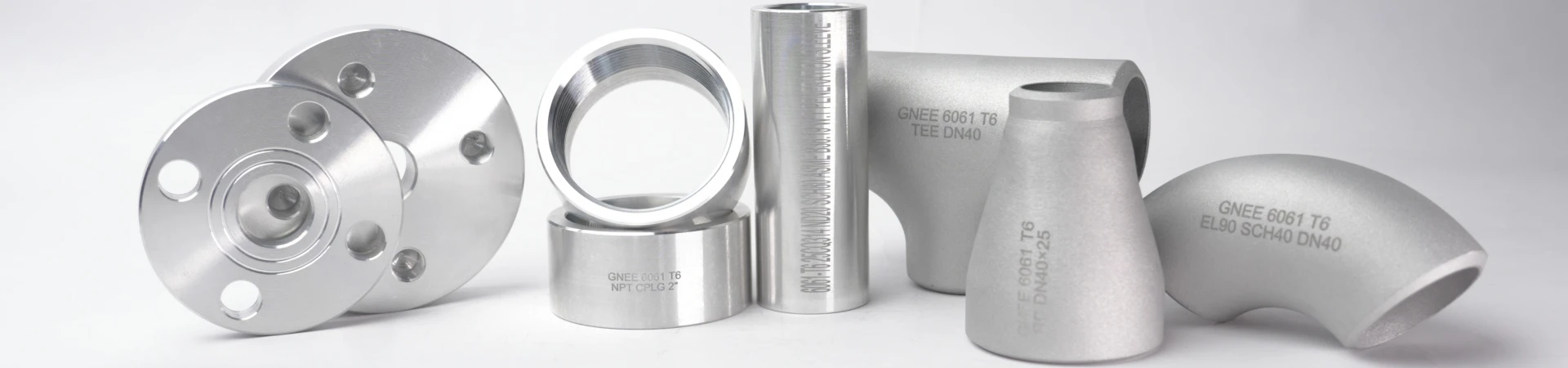


Henan Gnee New Material Co., Ltd. is one of the most reliable manufacturers and suppliers of butt-weld aluminum elbow in China. With abundant experience, we warmly welcome you to wholesale high quality butt-weld aluminum elbow in stock here from our factory. Good service and reasonable price are available.
A butt-weld aluminum elbow is a wrought pipe fitting that joins two lengths of pipe at an angle and is welded directly to the pipe ends. It belongs to the family of butt-welding fittings covered by ASTM B361 for material and ASME B16.9 for dimensions. The fitting is made from aluminum alloys rather than steel, so it weighs about one third as much as the same size in carbon steel while still handling low- and medium-pressure services where corrosion resistance and weight matter more than extreme pressure.
GNEE supplies butt-weld aluminum elbows in 90°, 45°, and 180° configurations, in long radius and short radius, across common grades such as 6061-T6, 6063-T5/T6, 5083, 5086, 3003, 1050, 1060, and 6082.
Butt-weld aluminum elbow
|
Attribute |
Typical value or range |
|
Product type |
Butt-weld (BW) elbow, beveled ends |
|
Angles |
90°, 45°, 180° (return), and custom angles |
|
Radius |
Long radius (LR, R = 1.5 × NPS); short radius (SR, R = 1.0 × NPS) |
|
Common alloys |
6061-T6, 6063-T5/T6, 5083, 5086, 3003, 1050, 1060, 6082 |
|
Material standard |
ASTM B361 (wrought aluminum welding fittings) |
|
Dimensional standard |
ASME B16.9 (LR); ASME B16.28 (SR); EN, DIN, GB on request |
|
Size range |
DN15 to DN350 standard; larger sizes to NPS 48 per drawing |
|
Wall thickness |
Sch 5S, 10S, 40S, 80S, or specified mm |
|
End preparation |
Beveled ends ready for butt welding |
|
Surface |
Mill finish, anodized, or as specified |
Read More:Aluminum Elbow


How a butt-weld elbow works
The elbow has the same outside diameter and wall thickness as the connecting pipe. A fitter aligns it with the pipe ends and makes a full-penetration butt weld around the joint, producing a continuous, smooth bore with no sudden step inside the line. That smooth transition keeps flow resistance low and makes cleaning easier than threaded or socket connections.
Elbows are defined by two choices: the angle and the radius. The angle sets how far the pipe turns. The radius sets how gradual the turn is. A long-radius elbow (R = 1.5 × NPS) gives a smoother turn and lower pressure loss, while a short-radius elbow (R = 1.0 × NPS) saves space in tight layouts. For most process and utility piping, long radius is the default unless the layout is constrained.
Materials and standards
Aluminum alloys
The alloy and temper decide strength, corrosion behavior, and how the fitting is welded. Grades commonly ordered for aluminum butt-weld elbows:
6061-T6 is the general-purpose grade, with a good balance of strength, weldability, and corrosion resistance for HVAC, chilled water, and utility lines.
6063-T5/T6 machines and finishes well and is used in structural and architectural piping.
5083 and 5086 are the marine grades, with better resistance to saltwater than 6061, used on vessels and offshore systems.
3003, 1050, and 1060 are softer, more formable grades for non-demanding, non-corrosive or high-purity services.
6082 offers a higher strength-to-weight ratio for structural and transport applications.
Standards that apply
ASTM B361 is the specification for factory-made wrought aluminum and aluminum-alloy welding fittings. It covers material, manufacturing, and testing and lists the approved alloys.
ASME B16.9 defines the dimensions of long-radius butt-welding fittings, including center-to-end, outside diameter, and tolerances. This is the primary dimensional standard for these elbows.
ASME B16.28 defines short-radius elbows where a tighter turn is needed.
Elbows can also be produced to EN, DIN, or GB dimensions when a project calls for them. Send the applicable standard and GNEE will confirm compliance before quoting.
A note on pressure: aluminum butt-weld elbows are not assigned a fixed pressure class the way some flanged parts are. The working pressure depends on the wall thickness, alloy, temperature, and the applicable piping code. Confirm the allowable pressure with the design rather than assuming a steel-schedule rating.
Dimensions: 90° long-radius reference
The table shows representative ASME B16.9 center-to-end dimensions (A) for 90° long-radius elbows. Dimensions are material-independent, so they apply to aluminum the same as to steel of the same nominal size.
|
NPS |
DN |
Center-to-end A (mm) |
|
1/2 |
15 |
38 |
|
1 |
25 |
38 |
|
2 |
50 |
76 |
|
3 |
80 |
114 |
|
4 |
100 |
152 |
|
6 |
150 |
229 |
|
8 |
200 |
305 |
|
12 |
300 |
457 |
For 45° long-radius elbows, the center-to-end is about 0.414 × A. For 180° long-radius returns, the center-to-center dimension is 2 × A. Always confirm the full dimensions against the ordered size, angle, radius, and standard before production.

Applications of butt-weld aluminum elbows
Aluminum elbows fit services where weight and corrosion resistance matter more than very high pressure. Typical applications:
HVAC and chilled water. Cooling water, condenser water, and air-handling lines use aluminum for its light weight and heat conduction.
Marine and shipbuilding. Fresh-water, compressed-air, and utility lines on vessels use marine grades such as 5083 and 5086. Only specific alloys suit seawater exposure.
Water treatment. Filter lines, backwash lines, and clear-water piping use aluminum where the water chemistry is compatible.
Factory compressed air. Aluminum piping is popular for compressed-air systems because it is light and does not rust internally.
Chemical and industrial utility lines. Non-corrosive services at low or medium pressure can use aluminum elbows, provided the medium and temperature are checked against the alloy.
Tanks, vessels, and skids. Equipment nozzles and fabricated packages use butt-weld elbows for a clean, continuous joint.


Packaging
GNEE packs elbows for long-distance sea and air freight:
Beveled ends are protected with plastic caps or sleeves to prevent damage and contamination.
Each fitting is wrapped in protective film or VCI paper, then separated to avoid surface contact.
Standard sizes are packed in plywood cases or on wooden pallets; large or custom sizes use purpose-built crates.
Each package is marked with size, alloy, standard, heat or lot number, and purchase order for easy identification on arrival.
Palletized and crated loads are banded and wrapped to survive handling and transit.


Inspection and testing
Every order passes through documented checks before shipment:
Material verification. Mill certificate is reviewed and positive material identification (PMI) confirms the alloy on request.
Dimensional inspection. Center-to-end, outside diameter, wall thickness, and bevel angle are measured against ASME B16.9 tolerances.
Surface and visual inspection. Fittings are checked for cracks, laminations, and other defects; mill finish or specified surface is confirmed.
Weld and non-destructive checks. Welded-type fittings are inspected with penetrant testing (PT) where applicable.
Pressure testing. Hydrostatic or pneumatic testing is carried out when required by the project specification.
Documentation. A material test certificate to EN 10204 3.1, a dimensional report, and inspection records accompany the order. Third-party inspection by SGS, BV, or TUV can be arranged on request.

Advantages of buying from GNEE
18 years of export experience. GNEE has supplied aluminum pipe fittings to international projects across multiple regions since 2008.
Flexible MOQ. Minimum order quantity is set by the size and order volume, not a fixed number, so small and large buys are both workable.
Mixed orders welcome. You can combine multiple specifications, sizes, angles, and alloys in one order and one shipment.
Standards and traceability. Production follows ASTM B361 and ASME B16.9, with mill certificates and inspection records for every batch.
Lower weight, easier handling. Aluminum reduces structural load and simplifies installation on site.

Long radius vs short radius
|
Feature |
Long radius (LR) |
Short radius (SR) |
|
Radius |
1.5 × NPS |
1.0 × NPS |
|
Flow resistance |
Lower |
Higher |
|
Space needed |
More |
Less |
|
Standard |
ASME B16.9 |
ASME B16.28 |
|
Typical use |
General process and utility piping |
Tight layouts, space-limited runs |
Frequently asked questions
What is a butt-weld aluminum elbow?
It is a wrought aluminum fitting that connects two pipe ends at an angle and is joined by a butt weld. It is made to ASTM B361 for material and ASME B16.9 for dimensions, and it is used to change pipe direction in low and medium pressure systems where weight and corrosion resistance matter.
Which alloy should I choose for an aluminum elbow?
Use 6061-T6 or 6063 for general-purpose and HVAC service, 5083 or 5086 for marine and seawater exposure, 3003, 1050, or 1060 for non-demanding non-corrosive lines, and 6082 where a higher strength-to-weight ratio is needed.
What standards apply to aluminum butt-weld elbows?
Material follows ASTM B361. Dimensions follow ASME B16.9 for long-radius elbows and ASME B16.28 for short-radius elbows. EN, DIN, or GB dimensions can be supplied on request.
What sizes and angles are available?
Standard sizes run from DN15 to DN350, with larger sizes up to NPS 48 made to drawing. Angles include 90°, 45°, 180° returns, and custom angles. Both long-radius and short-radius versions are available.
Can aluminum elbows handle the same pressure as steel elbows?
Not by a fixed class. The working pressure depends on wall thickness, alloy, temperature, and the applicable code, so it should be confirmed by the design rather than read from a steel schedule.
How are the elbows packaged and inspected?
Ends are protected, fittings are wrapped and crated for freight, and each order is checked for material, dimensions, and surface condition, with a mill certificate to EN 10204 3.1 and optional third-party inspection.
What is GNEE's MOQ and can I mix sizes?
Minimum order quantity depends on the size and order volume, so it is flexible. You can combine several specifications, sizes, angles, and alloys in one order and one shipment.
Request a quote
Send the alloy, angle, nominal size, wall thickness, radius (LR or SR), standard, surface, and quantity, and GNEE will return a quote with lead time and documentation. A complete inquiry looks like this: "Aluminum butt-weld elbow, 6061-T6, 90°, DN100, Sch 10S, LR, ASME B16.9, mill finish, 200 pcs." For non-standard angles, radii, or wall thicknesses, send a dimensioned drawing and our engineers will review it with you.
Hot Tags: butt-weld aluminum elbow, China butt-weld aluminum elbow manufacturers, suppliers, factory