


Aluminum Pipe
GNEE: Aluminum Pipe Manufacturer in China
Quick delivery
Delivery in 7–15 days
OEM customization
Experienced
18+ years production experience
Export to 100+ countries
Reliable quality
SGS, ISO 9001, CE, SGS/BV etc. certified
24/7 Support
Dedicated business support, get a quote within 24 hours.
-
![AMS 6061 Aerospace Aluminum Tube]() AMS 6061 Aerospace Aluminum TubeThe 6061 alloy is well known as a "universal alloy" because of its broad variety of applications and complete performance qualities. T6 and T4 tempers are the most commonly utilized because to...read more
AMS 6061 Aerospace Aluminum TubeThe 6061 alloy is well known as a "universal alloy" because of its broad variety of applications and complete performance qualities. T6 and T4 tempers are the most commonly utilized because to...read more -
![Aluminium Extrusion Square Tube]() Aluminium Extrusion Square TubeAluminum square tube is Al-Mg-Si alloy, medium strength, good plasticity and excellent corrosion resistance, and has a wide range of industrial uses.read more
Aluminium Extrusion Square TubeAluminum square tube is Al-Mg-Si alloy, medium strength, good plasticity and excellent corrosion resistance, and has a wide range of industrial uses.read more -
![1100 Aluminum Tube]() 1100 Aluminum TubeWith an aluminum content of ≥ 99.0%, 1100 Aluminum Tube is an industrial pure aluminum tube that provides outstanding formability, weldability, corrosion resistance, and thermal conductivity. ...read more
1100 Aluminum TubeWith an aluminum content of ≥ 99.0%, 1100 Aluminum Tube is an industrial pure aluminum tube that provides outstanding formability, weldability, corrosion resistance, and thermal conductivity. ...read more -
![Aluminum Profile Tube]() Aluminum Profile TubeAluminum profiled tubing is a type of aluminum alloy tubing with a non-circular cross-section and a shape that can be customized for specific applications.read more
Aluminum Profile TubeAluminum profiled tubing is a type of aluminum alloy tubing with a non-circular cross-section and a shape that can be customized for specific applications.read more -
![6082 T6 Aerospace Aluminum Pipe Tube]() 6082 T6 Aerospace Aluminum Pipe TubeA high-strength, corrosion-resistant aluminum alloy tube, 6082 T6 Aerospace Aluminum Pipe is typically utilized in the production of airplanes and other aviation components. The strongest of the...read more
6082 T6 Aerospace Aluminum Pipe TubeA high-strength, corrosion-resistant aluminum alloy tube, 6082 T6 Aerospace Aluminum Pipe is typically utilized in the production of airplanes and other aviation components. The strongest of the...read more -
![7005 Aluminum Tube Pipe]() 7005 Aluminum Tube PipeThe 7000 high-strength aviation alloy 7005 Aluminum Tube Pipe is lightweight, strong, easy to work with, and has good welding capabilities. For joining frame structures, it is simple to process...read more
7005 Aluminum Tube PipeThe 7000 high-strength aviation alloy 7005 Aluminum Tube Pipe is lightweight, strong, easy to work with, and has good welding capabilities. For joining frame structures, it is simple to process...read more -
![2024 Aluminum Square Tube]() 2024 Aluminum Square TubeHigh-strength aerospace alloy 2024 aluminum square tube is renowned for its exceptional machinability, fatigue resistance, and hardness. It is extensively utilized in high-performance athletic...read more
2024 Aluminum Square TubeHigh-strength aerospace alloy 2024 aluminum square tube is renowned for its exceptional machinability, fatigue resistance, and hardness. It is extensively utilized in high-performance athletic...read more -
![5083 Aluminum Square Tube]() 5083 Aluminum Square TubeThe main alloying element of 5083 aluminum profile is magnesium, which has good forming and processing performance, weldability, and is used in the manufacture of aircraft fuel tanks, fuel pipes,...read more
5083 Aluminum Square TubeThe main alloying element of 5083 aluminum profile is magnesium, which has good forming and processing performance, weldability, and is used in the manufacture of aircraft fuel tanks, fuel pipes,...read more -
![6061 T6 Welded Aluminum Straight Round Tubing]() 6061 T6 Welded Aluminum Straight Round Tubing6061 T6 Welded Aluminum Straight Round Tubing is a popular heat-treatable aluminum alloy pipe that has high strength, corrosion resistance, machinability, and moderate welding performance.It is...read more
6061 T6 Welded Aluminum Straight Round Tubing6061 T6 Welded Aluminum Straight Round Tubing is a popular heat-treatable aluminum alloy pipe that has high strength, corrosion resistance, machinability, and moderate welding performance.It is...read more -
![AMS 2024 T3 T4 Aircraft Drawn Aluminum Tube]() AMS 2024 T3 T4 Aircraft Drawn Aluminum TubeComposite AMS 4083, AMS 4086, AMS 4087, and AMS 4088 are product standards for AMS 2024 T3 T4 aircraft drawn aluminum tube, a high-strength, lightweight, corrosion-resistant aviation-grade...read more
AMS 2024 T3 T4 Aircraft Drawn Aluminum TubeComposite AMS 4083, AMS 4086, AMS 4087, and AMS 4088 are product standards for AMS 2024 T3 T4 aircraft drawn aluminum tube, a high-strength, lightweight, corrosion-resistant aviation-grade...read more -
![6061 6063 T6 Aluminum Tube For Connector Sensor Protection]() 6061 6063 T6 Aluminum Tube For Connector Sensor Protection6061 6063-T6 aluminum tubes engineered for connector and sensor protection, featuring tight tolerances and high-quality anodized surfaces for reliable performance in harsh environments.read more
6061 6063 T6 Aluminum Tube For Connector Sensor Protection6061 6063-T6 aluminum tubes engineered for connector and sensor protection, featuring tight tolerances and high-quality anodized surfaces for reliable performance in harsh environments.read more -
![ASTM B241 1100-H112 Aluminum Seamless Pipe]() ASTM B241 1100-H112 Aluminum Seamless PipeThe ASTM B241 Aluminum 1100-H112 Seamless Pipe is an industry-standard solution for non-structural applications requiring excellent corrosion resistance and high thermal conductivity.read more
ASTM B241 1100-H112 Aluminum Seamless PipeThe ASTM B241 Aluminum 1100-H112 Seamless Pipe is an industry-standard solution for non-structural applications requiring excellent corrosion resistance and high thermal conductivity.read more


GNEE Comprehensive Aluminum Pipe & Tube Specifications
As a leading manufacturer, we possess strong extrusion and drawing capabilities. Below is our standard manufacturing range.
| Alloy Grade | Tempers | Outer Diameter (OD) / mm | Wall Thickness (WT) / mm |
| 1050, 1060, 1100 | O, H14, H16, H18, H19 | 2 - 1000 | 0.5 - 50 |
| 2011, 2014, 2024, 2219, 2A11, 2A12, 2A14 | O, T3, T6, T64, T451, T651 | 6 - 500 | 1 - 25 |
| 3003, 3004, 3005, 3105 | O, H14, H18, H24, H34, H36, H38 | 3 - 500 | 0.5 - 50 |
| 5005, 5052, 5083, 5086, 5251 | O, H32, H34, H36, H38, H111, H112, H116, H321 | 4 - 600 | 1 - 25 |
| 6060, 6061, 6063, 6082 | O, H32, H112, T4, T5, T6, T651 | 3 - 800 | 0.5 - 50 |
| 7005, 7046, 7050, 7075 | O, T6, T73, T76, T651, T7351 | 6 - 500 | 0.5 - 30 |
Can't find your specific size or alloy in the table?
Don't worry! The table above only shows our common specifications. We specialize in Custom Extrusion and Precision Drawing. Whether you need ultra-thin walls, large diameters, or special profiles, we can customize it for you.
Which Aluminum Pipe Fits Your Project?
We extrude and draw aluminum pipes for various industries. Here are the most common uses and recommended alloys:
| Industry / Project | Recommended Alloy | Common Uses |
| Construction & Scaffolding | 6061-T6, 6082-T6 | Heavy-duty scaffolding pipes, structural frames, and handrails. |
| Marine & Offshore | 5083, 5052 | Boat railings, marine piping systems, yacht frames. |
| Automotive & Sporting | 7075-T6, 2024-T3 | High-strength bike frames, shock absorbers, tent poles. |
| Industrial & HVAC | 3003, 1060, 6063 | Heat exchangers, pneumatic cylinders, irrigation pipes. |
Aluminum Pipe Price Guide
At GNEE, we offer direct-mill transparent pricing. Our price formula is:
Current SMM (Shanghai Metals Market) Aluminum Ingot Price + Extrusion/Processing Fee.
The extrusion fee depends on the alloy, wall thickness, and whether it is a standard extruded pipe or a seamless drawn pipe.
Note: Ingot prices change daily. Please send us your OD (Outer Diameter) and WT (Wall Thickness) for today's exact quote.
Types of Aluminum Pipe


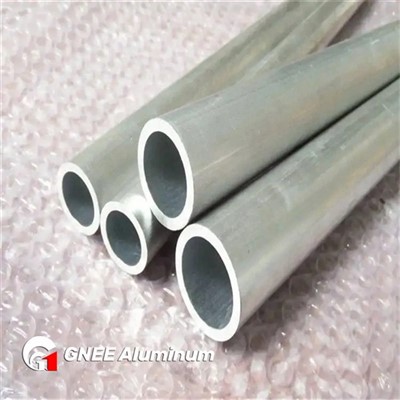
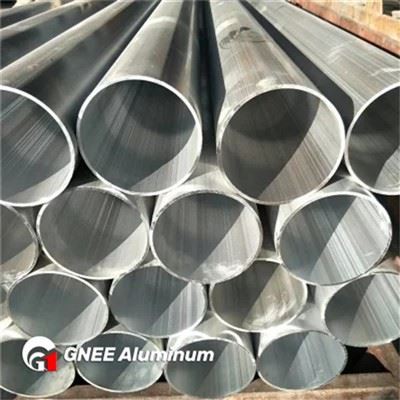
Seamless Aluminum Pipes
Seamless Aluminum Pipes are made by drawing a solid aluminum billet through a die to create a hollow tube. They have no seams or welds, which makes them stronger and more reliable than welded tubes. Seamless Aluminum Pipes are commonly used in high-pressure applications, such as hydraulic systems, heat exchangers, and air conditioning systems. They are also used in the aerospace industry for fuel and hydraulic lines.
Welded Aluminum Pipes
Aluminum Pipes that are welded together from two or more pieces of aluminum are known as welded Aluminum Pipes. While they are more affordable than seamless tubes, they are not as robust. Welded tubes are frequently used in applications that do not require high pressure, such as furniture, fences, and light fixtures. Additionally, they are used in the automotive industry for exhaust systems.
Drawn Aluminum Pipes
Drawn Aluminum Pipes are made by drawing a solid aluminum rod through a die to create a hollow tube. They have a smooth surface finish and are used in applications that require a high level of precision, such as instrumentation, telecommunications, and aerospace. Drawn Aluminum Pipes are also used in the medical industry for catheters and other medical devices.
Extruded Aluminum Pipes
Extruded Aluminum Pipes are produced by pushing heated aluminum billets through a die to form a hollow tube. With a uniform cross-section, they are ideal for applications that demand a high degree of structural integrity, such as construction, transportation, and marine applications. In addition, extruded Aluminum Pipes are employed in the automotive industry for structural components and radiator supports.
Finned Aluminum Pipes
Finned Aluminum Pipes are used in heat transfer applications. They have fins on the outside of the tube that increase the surface area and improve heat transfer efficiency. Finned Aluminum Pipes are commonly used in air conditioning and refrigeration systems, as well as in heat exchangers for the aerospace and automotive industries.
Coiled Aluminum Pipes
Aluminum Pipes that are coiled into a smaller diameter coil are known as coiled Aluminum Pipes. They are utilized in applications that require flexibility and easy installation, such as refrigeration and air conditioning systems. Coiled Aluminum Pipes are created by coiling a lengthy section of aluminum tubing. Furthermore, they are used in the medical industry for medical devices such as catheters.
Square Aluminum Pipes
Square Aluminum Pipes are used in applications that require a high level of structural integrity, such as construction, transportation, and marine applications. They have a square cross-section and are used as structural components for frames, supports, and rails. Square Aluminum Pipes are also used in the automotive industry for suspension components and body structures.
Rectangular Aluminum Pipes
Rectangular Aluminum Pipes are akin to square tubes, with the distinction being their rectangular cross-section. While they can be used in similar applications to square tubes, they are better suited for applications requiring a wider profile, such as trailer frames and boat docks.
Hollow Aluminum Pipes
Hollow Aluminum Pipes are used in applications that require a lightweight and rigid structure, such as antennas, flagpoles, and furniture. They have a hollow center and are commonly made from extruded aluminum. Hollow Aluminum Pipes are also used in the automotive industry for shock absorbers and steering components.
Seamless vs. Extruded Pipes: How to Choose?
Many buyers get confused. Here is the simple rule to choose the right pipe for your project:
Extruded Aluminum Pipe (Porthole Die):
Has weld lines (invisible to the eye).
Cheaper and faster to make.
Best for: Furniture, tents, architectural frames, handrails, and general structures.
Seamless Aluminum Pipe (Mandrel Extrusion/Drawn):
No weld lines at all.
Higher burst pressure and better for anodizing.
Best for: Hydraulic systems, HVAC (air conditioning), gas cylinders, and high-pressure parts.
Process of Aluminum Pipe
Extrusion die to the extrusion press
A circular die is typically crafted from h13 steel. If an appropriate die is available, it is retrieved from storage. Prior to extrusion, the die must be preheated to temperatures between 450 and 500 degrees celsius. This preheating helps extend the die's lifespan and ensures a consistent metal flow. Once preheated, the die is ready to be installed in the extrusion press.
Preheated aluminum billet pre-extrusion
Next, a cylindrical block of aluminum alloy, known as a billet, is cut from a larger batch of alloy material. This billet is then placed in an oven and heated to temperatures between 400 and 500 degrees celsius. The heating process makes the billet malleable enough for extrusion, but it does not reach a molten state.
Billet moved to the extrusion press
As soon as the billet is done preheating, it is mechanically moved to the extrusion press. Before loading it onto the press, a lubricant or release agent is applied to it. The release agent is also applied on the extrusion ram to prevent the ram and billet from sticking together.
Pushing the billet into the container
The malleable billet is then loaded into the extrusion press, where a hydraulic ram applies 15,000 tons of pressure. This immense force pushes the billet into the extrusion press’s chamber, causing the metal to expand and conform to the shape of the container walls.
Extruded solids
As the metal alloy fills the chamber, it is forced against the extrusion die. The sustained pressure confines the aluminum, allowing it to pass only through the openings of the die. The result is a completed pipe or tube that emerges from the die.
Running and quenching extrusions
Once the extrusion exits the die, a puller takes hold of it and guides it along the run-out table, synchronizing with its exit speed from the press. During this process, the pipe or tube is "quenched" by cooling it consistently, either with a fan positioned above the table or through a water bath.
Cut to table-length extrusions
After the extrusion reaches its full length on the table, it is cut using a heated saw to detach it from the extrusion process. Temperature is crucial throughout the entire procedure. Even though the extrusion is rapidly cooled after exiting the press, it remains warm and hasn't fully cooled down yet.
Cooling extrusions
Once cut, the extrusions are mechanically transferred from the run-out table to a cooling table. They remain there until they reach ambient temperature. After cooling, the next step involves stretching the pipes or tubes.
Stretcher transfer and stretched to alignment
Natural twisting in the pipes or tubes must be corrected. This is done by moving them to a stretcher, where each piece is clamped at both ends and stretched until it is straightened and meets the required specifications.
Cutting to length extrusions
Once the extrusion has been straightened and work-hardened, it is transferred to the saw table. Here, it is cut into predetermined lengths, typically ranging from 8 to 21 feet (2.4 to 6.4 meters). At this stage, the extrusion exhibits the t4 temper. Following the cutting process, the extrusions may be placed in an oven for aging to achieve the t6 or t5 temper.
Heat treating, finishing, and fabrication
After the extrusion process is complete, the pipes or tubes may undergo heat treatment to enhance their properties. Following this, various surface finishes are applied to boost their aesthetic appeal and provide better corrosion resistance. After heat treatment, piping is finished.
How to Choose a Aluminum Pipe
Material specifications
When choosing aluminum pipes and tubes, examine the material specifications like alloy type, temper, and mechanical properties. Different alloys and tempers offer various combinations of strength, corrosion resistance, and machinability. This is similar to selecting the right type of wood for furniture: hardwood for durability and softwood for ease of carving.
Dimensional accuracy
Check the dimensional tolerances required for your specific application. If the project demands high precision, options like drawn-over mandrel (DOM) tubes may be more suitable. Think of this as choosing a fine-tipped pen for detailed illustrations instead of a broad-tipped marker suitable for bold strokes.
Wall thickness
The choice of wall thickness will depend on the intended use, particularly concerning pressure resistance or structural integrity. Thicker walls offer greater strength but add weight and may require specialized connections. It’s like choosing between a thin or thick rope based on the weight it needs to support.
Application environment
Think about aluminum types with higher corrosion resistance or specialized coatings for outdoor or corrosive environments. This can be likened to opting for all-weather tires for a vehicle facing various road conditions.
Certifications and standards
Always check for relevant industry certifications and standards like ASTM, ASME, or ISO to ensure the material’s quality and suitability for your application.
Consult experts
If the application is specialized or complex, consult experts or engineers with aluminum materials experience in similar situations. Similarly, if you were dealing with a complex medical condition, you’d consult a specialist rather than relying solely on general advice.
Finish of the Aluminum Piping
Galvanized
A zinc layer is added for additional corrosion resistance.
Bright Finish
Mirror-polished surfaces are created to have a shiny look.

Plated
Thin layer of another metal is deposited to improve its corrosion resistance and conductivity.
Painted
Pipes and tubes are painted to increase corrosion resistance or for identification purposes
Our Factory
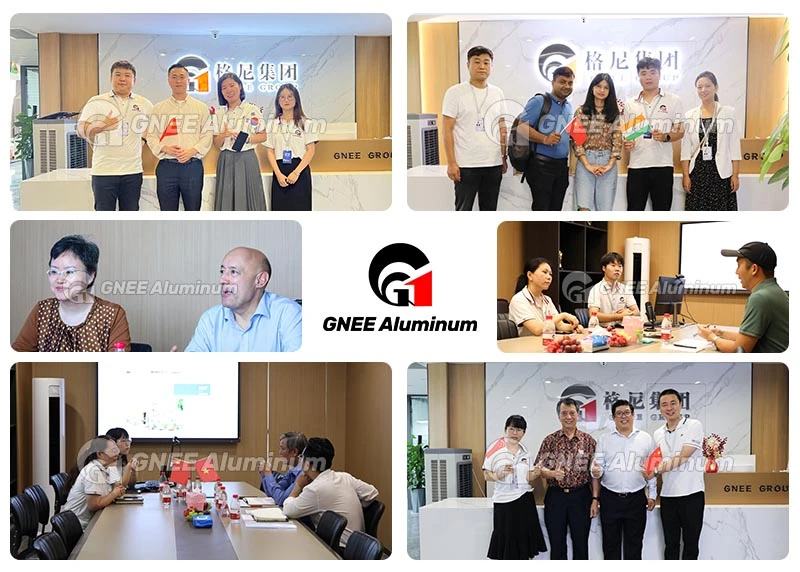
Henan Gnee New Material Co., Ltd. is a modern supply chain enterprise with aluminum processing, sales, and distribution as its core industries. It was established in 2008. After about 18 years of development, it has customers in more than 100 countries and regions around the world.The company specializes in the production of high-quality aluminum products, including aluminum foil, aluminum tubes, aluminum alloy plates, aluminum rods, aluminum coils, etc.

Why Choose Us
Our factory
Henan Gnee New Material Co., Ltd. has 5 subsidiaries located in Anyang, Tianjin, Hong Kong, Singapore, and other countries and regions. The headquarters is located in Anyang City, the hometown of Oracle, the site of the world cultural heritage "Yin Ruins," and one of the eight ancient capitals of China.
Quality control
The company strictly implements the 6S management system and passed the ISO9001 international quality system certification and GJB9001B-2009 national military standard quality management system certification in 2016.
24h online service
We try to respond to all concerns within 24 hours and our teams are always at your disposal in case of any emergencies.
Our Extrusion Factory & Quality Control
We are a direct aluminum extrusion factory. We control the precision from billet casting to final drawing.
Production Capacity:
10 Extrusion Lines: Presses ranging from 600T to 4,000T (Capable of making large-diameter pipes).
5,000 Tons monthly production capacity.
In-house die/mold workshop (Custom molds ready in 7-10 days).
Strict Tolerances & NDT Testing:
- Concentricity & Tolerance: Outer Diameter (OD) and Wall Thickness (WT) tolerances are controlled within ±0.05mm. High concentricity ensures low scrap rate when you do CNC machining.
- Testing: We use Spectrometers (OES) to guarantee pure chemical composition. For pressure pipes and aerospace grades, we perform Eddy Current Testing (ECT) or Ultrasonic Testing (UT) to ensure zero internal defects or hidden cracks.
Our Certificates


FAQ
Henan Gnee New Material Co., Ltd. is one of the most professional aluminum pipe manufacturers and suppliers in China, featured by quality products and competitive price. Please rest assured to buy aluminum pipe for sale here from our factory.
aluminum pipe couplings, gold aluminum pipe, aluminum pipe for instrumentation