

Flange material is not one property. It is a grade, a product form, a heat treatment and a rating route. Two flanges with the same grade can have different minimums, different ratings and different certificates. This guide compares the common materials, shows where each one fits, and lists what to put on the purchase order.
GNEE supplies aluminum flanges and flanges made from other commonly used materials, supporting different piping requirements across industrial applications. With a range of material options and specifications, we help buyers evaluate suitable flange solutions based on operating conditions, connection requirements, and project standards.
Discuss Your Flange Requirements
1. What materials are used for pipe flanges?
Seven families cover most pressure piping. Each one has its own material standard, product forms and rating route.
| Family | Common grades | Typical service | Avoid or review | Rating route |
|---|---|---|---|---|
| Carbon steel | A105, A350 LF2, A216 WCB | Water, oil, gas, steam and hydrocarbons in mildly corrosive service; LF2 for low-temperature toughness | Acids, chlorides, seawater, wet H2S without NACE compliance; long service above about 427°C | B16.5 Group 1.1; B16.47 for large sizes |
| Austenitic stainless | F304/F304L, F316/F316L; cast CF8/CF8M | Food, water, mild chemicals, pulp and paper, pharmaceutical | Hot chlorides with stress; continuous seawater; strong reducing acids; L grades above 427°C | B16.5 Groups 2.1, 2.2, 2.3 |
| Cr-Mo alloy steel | F11 Cl.2, F22 Cl.3, F91 | High-temperature steam, power and refinery piping where creep strength governs | Corrosive or wet service; welds without the specified preheat and PWHT | B16.5 Groups 1.9, 1.10, 1.15 |
| Duplex and super duplex | F51 (2205), F53 (2507), F55 (S32760) | Chloride water, seawater cooling, desalination, offshore, chemical piping | Continuous service above 300°C; 350–550°C embrittlement; 600–950°C sigma phase | B16.5 Group 2.13 |
| Aluminum | 6061-T6, 5083-O, 5083-H116, 5086, 6082 | Dry air, vacuum, cooling circuits, lightweight skids, marine water lines, cryogenic equipment | Wet or chloride air, strong acids and alkalis, hot service, welded joints designed to parent T6 values | B31.3 Appendix L (6061-T6, 3003-H112); EN 1092-4 (5083-O, 6061-T6) |
| Nickel alloy | 625, C-276, 825, Monel 400 | Aggressive chlorides, seawater, HF, sulfuric and phosphoric acid, chemical process equipment | Media outside the published corrosion envelope; high-temperature pressure duty claimed from oxidation data | B16.5 Group 3.4 (Monel 400), Group 3.8 (625, 825, C-276) |
| Cast iron and copper alloy | Gray iron, ductile iron; bronze, brass | Low-pressure water, HVAC, utilities, marine plumbing | Steel pipe classes; high pressure or temperature | ASME B16.1; EN 1092-2/-3 |
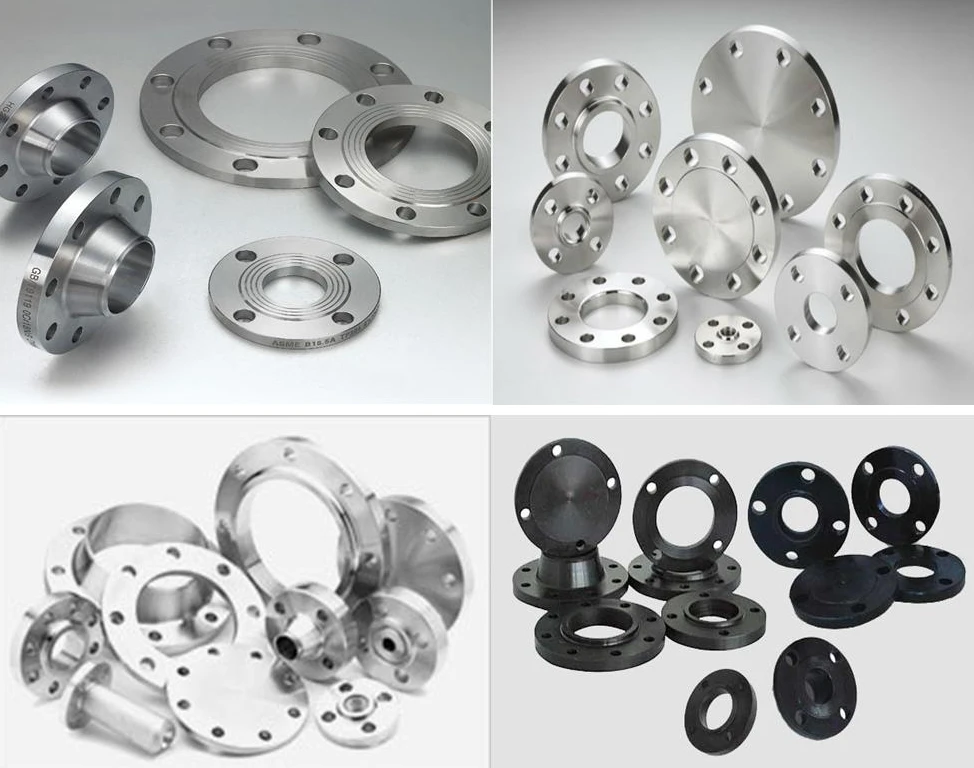
2.Common Flange Materials and Grades
Flange material grades pair a material standard with a grade and a temper or class. The same alloy as forging, plate or extrusion carries different values.
Carbon Steel Grades: A105, A350 LF2
A carbon steel blind flange is commonly used to seal the end of a pipeline, but it requires coating or cladding in wet or corrosive service. Carbon steel weld neck flanges are among the most widely specified forged products for high-pressure piping, typically supplied to ASTM A105. A105 has 485 MPa minimum tensile and 250 MPa yield; A350 LF2 is the low-temperature grade with Charpy testing. Cast equivalents are A216 WCB and A351 CF.
Stainless Steel Grades: F304, F304L, F316, F316L
ASTM A182 F304 and F316 are the base austenitic forging grades at 515 MPa tensile and 205 MPa yield; F304L and F316L have 485/170 MPa minimums and reduce sensitization after welding. Plate forms are ASTM A240.

Alloy Steel Grades: F11, F22, F91
ASTM A182 F11, F22 and F91 are chromium-molybdenum forgings with 415–515 MPa tensile and 205–310 MPa yield; F91 yield is 415 MPa. Temperature ceilings are about 540°C, 580°C and 600–650°C. Post-weld heat treatment is applied by code, with F91 the tightest; external corrosion protection is required.
Duplex Grades: F51, F53, F55
F51 is the 2205 duplex designation at 620/450 MPa minimums. F53 (2507) and F55 are super duplex at 750–800/550 MPa, with PREN about 35 for F51 and 40–45 or higher for super duplex. All are ASTM A182 forgings, normally without post-weld heat treatment, with controlled heat input and rapid cooling.

Aluminum Alloy Grades: 6061, 5083, 5086, 6082
A 6061 aluminum flange in T6 temper reaches 260–290 MPa tensile and 240 MPa yield minimums as an ASTM B247 forging. 5083-H116 reaches 290–305 MPa tensile with 215 MPa yield as ASTM B209 or EN 485 plate used in seawater. 5086-H116 is cited at 275–315 MPa tensile and 210–230 MPa yield in the same plate forms; these are typical product values marked indicative, not specification minimums. 6082-T6 gives 310/260 MPa. Limits are about 65°C for 5xxx and 150°C for 6xxx.

Nickel Alloy Grades: Inconel, Monel, Hastelloy
Inconel 625 (N06625) gives 827/414 MPa minimums with capability near 980°C; Hastelloy C-276 (N10276) 690/283 MPa, Inconel 825 (N08825) 586/241 MPa, Monel 400 (N04400) 480–485/170–195 MPa. All are ASTM B564 forgings; selection follows the medium and a cost index of 10–20 times carbon steel.
3. Limits and comparisons
3.1 Temperature
A table end is not a design target. The practical limit is usually lower, and it is set by the medium as well as the metal.
| Material | Group | Table end | Practical limit | What to state |
|---|---|---|---|---|
| A105 / A350 LF2 | 1.1 | 538°C | Long service above about 427°C is not recommended for A105; LF2 is a low-temperature grade | Design temperature, impact temperature for LF2 |
| F304 / F304H | 2.1 | 816°C | Sensitization risk in 425–860°C if the part later sees wet service | 304, 304L or 304H; post-weld condition |
| F304L | 2.3 | 427°C | Not to be used above 427°C in B16.5 | Why L is required; change grade if hotter |
| F316 / F316H | 2.2 | 816°C | Same sensitization caution as 304 | 316, 316L or 316H |
| F316L | 2.3 | 427°C | Not to be used above 427°C in B16.5 | Use 316H or another group if hotter |
| F11 Cl.2 | 1.9 | 649°C; Class 150 ends at 538°C | Creep data governs, not the table end | Class, PWHT, design temperature |
| F22 Cl.3 | 1.10 | 649°C | Hydrogen service needs a Nelson-curve check | Hydrogen partial pressure, PWHT, hardness |
| F91 | 1.15 | 649°C | About 600°C is the common design range; the table edge is not a target | PWHT at 746–760°C, hardness, welding procedure |
| F51 (2205) | 2.13 | Read the group table | −50 to 300°C; 350–550°C embrittlement; 600–950°C sigma phase | Design temperature, chloride level, heat input |
| F53 / F55 | 2.13 | Read the group table | Not above +300°C; some pressure-vessel approvals stop at 250°C. F53 and F55 are different alloys | Grade, code approval, welding procedure |
| 6061-T6 | None | App L; EN 1092-4 | Strength falls above about 150°C and sharply above 200°C. This is a material reference, not a rating temperature | Rating route, form, design temperature, joint design |
| 5083-O / 5083-H116 | None | EN 1092-4 (O only) | No fixed ceiling. Sensitization depends on alloy, temper, temperature and time. H116 is controlled but not immune | Exposure temperature and duration, rating route, welding procedure |
| 5086 / 6082 | None | No published rating | 5086: same time and temperature risk as other 5xxx alloys. 6082: strength falls with temperature | Design calculation, thickness, owner approval |
| 625 / C-276 / 825 | 3.8 | Read the group table | Wet-corrosion duty is medium-specific. The 980°C oxidation figure for 625 is not a pressure rating | Medium, concentration, temperature, aeration |
| Monel 400 | 3.4 | Read the group table | Wet-corrosion duty is medium-specific; HF needs no air or oxidants | Medium, aeration, flow, H2S |
3.2 Corrosion
PREN is useful for stainless and duplex. It is not directly comparable across nickel alloys.
| Material | PREN | Chloride and seawater | Acids and process media | Key limit |
|---|---|---|---|---|
| A105 | - | Poor; needs coating, cladding or cathodic protection | Mildly corrosive water, oil, gas, steam | General corrosion; graphitization above about 427°C |
| 304 / 304L | 18–20 | Pitting in warm chloride; SCC risk rises above about 50°C with stress | Food, beverage, mild organic chemicals | Hot chloride; strong reducing acids |
| 316 / 316L | 24–26 | Better than 304; SCC risk still assessed from about 50–60°C | Chemical, pulp and paper, food, hot water | Hot chloride; crevices; continuous seawater |
| F51 (2205) | about 35 | Good for seawater cooling and desalination within the temperature limit | Chemical, oil and gas, heat exchangers | Above 300°C; strong reducing acids |
| F53 (2507) | 40–45 | Excellent for aggressive seawater and offshore service | Aggressive chloride and chemical service | Above 300°C; welding control |
| F55 (S32760) | Use mill data | Super duplex; do not apply F53 data | As confirmed for S32760 | Alloy-specific; different from F53 |
| 6061-T6 | - | Moderate; pitting in wet or crevice conditions | Dry air, vacuum, cooling circuits | Wet air, chlorides, strong acids and alkalis |
| 5083 / 5086 | - | Good marine resistance; not immune in stagnant or high-velocity flow | Marine water, ballast, drainage, cryogenic tanks | Sensitization risk with temperature and time; erosion-corrosion |
| 625 | Not comparable | Excellent pitting, crevice and SCC resistance | Broad chemical service, including chlorides | Cost; oxidation data is not a rating |
| C-276 | Not comparable | Excellent against chloride pitting, crevice and SCC | Both oxidizing and reducing acids | Hot oxidizing service; cost |
| 825 | - | Good in seawater; assess crevices | Sulfuric acid within the published envelope; phosphoric acid | Dilute sulfuric above about 65°C; contaminated acid |
| Monel 400 | - | Good in flowing seawater; poor in stagnant or H2S-bearing water | HF without air or oxidants; alkalis; salts | Oxidizing acids; aerated HF |
3.3 Weight and stiffness
| Material | Density, g/cm³ | Elastic modulus, GPa | Weight vs steel | What it means |
|---|---|---|---|---|
| A105 | 7.85 | 200 | 1.00 | Reference |
| F316 | 8.00 | 193 | 1.02 | About 2% heavier at equal volume |
| F51 | 7.80 | 200 | 0.99 | Higher strength can allow a thinner section in some designs |
| 6061-T6 | 2.70 | 69 | 0.34 | Much lighter, but about one third the stiffness |
| 5083-H116 | 2.66 | 70 | 0.34 | Same weight advantage; no EN 1092-4 rating |
| 625 | 8.44 | 205 | 1.08 | Heavier than steel; weight is not the reason to buy it |
Actual flange weight follows the drawing, not the density ratio. Thicker aluminum sections are often needed for stiffness and gasket seating.
3.4 Welding and repair
| Material | Welding | Post-weld heat treatment | HAZ and repair |
|---|---|---|---|
| A105 / A350 LF2 | Routine; match the pipe grade | Per code and wall thickness | Repair allowed under an approved procedure; hardness control for sour service |
| 304 / 316 and L grades | Routine; low-carbon grades reduce sensitization risk | Not normally required; solution annealing if specified | Sensitization risk in 425–860°C; pickle and passivate after welding |
| F11 / F22 | Preheat and controlled heat input | Required | Hardness and PWHT records are acceptance items |
| F91 | Preheat about 200°C; qualified procedure essential | Required on all welds, typically 746–760°C | Hardness control; poor PWHT cannot be fixed by inspection |
| F51 / F53 / F55 | Controlled heat input, interpass temperature and cooling | Not normally applied | Ferrite balance; avoid sigma and alpha-prime; repair only under procedure |
| 6061-T6 | TIG/MIG; ER5356 or ER5183 common. ER4043 is not banned, but filler choice must suit strength, temperature and corrosion | No post-weld age hardening in the shop unless specified | Welding softens the T6 HAZ. Design to code and qualified procedure, not to a fixed percentage of T6 strength |
| 5083 / 5086 | TIG/MIG; 5183 or 5556 commonly preferred for marine 5083 | Not applicable | HAZ is softer than parent metal; design to the as-welded condition |
| 625 / C-276 / 825 / Monel 400 | Matching filler; low heat input preferred | Not normally required for 625 and C-276 | Work hardening; cleanliness is critical |
Repair welding is not one rule. EN 1092-4 clause 5.2 does not allow repair welding of flanges made to that standard. ASME B31.3 Appendix L is not an outright ban: it limits repair by flange type, repaired area and approval conditions. Check which standard the flange is ordered to before accepting or rejecting a repair.
3.5 Cost
Cost depends on alloy, form, size, quantity and inspection. A ratio without those details is misleading, so the comparison below is qualitative.
| Material | Cost factors | Availability and lead time |
|---|---|---|
| A105 | Low material cost; coating and maintenance add lifecycle cost | Widely stocked; lead time set by size and class |
| 304 / 304L | Higher than carbon steel; broad supply | Common; certificate scope drives lead time |
| 316 / 316L | Higher than 304 because of molybdenum and higher nickel | Common; PMI and third-party inspection add time |
| Cr-Mo / F91 | Alloy and heat-treatment cost; F91 also needs qualified welding | F91 is less common than F22; PWHT sets the schedule |
| Duplex / super duplex | Higher alloy and processing cost; tighter fabrication control | Super duplex has a narrower mill base |
| 6061-T6 | Low density; cost driven by forging, machining and rating route | Widely available |
| 5083 / 5086 | Marine-grade material, temper, thickness and certification | Marine plate stock; class-society approval adds time |
| 625 / 825 / C-276 / Monel 400 | High alloy cost; small lots and inspection can dominate the price | Often made to order; melt and forge schedule governs |
4. Applicable Scope for Each Type of Flange Material
This is the practical part. The question is not which material is strongest, but which one is normally specified for the duty and what makes it a poor choice.
| Material | Use it for | Avoid or review | Check before ordering |
|---|---|---|---|
| A105 | Water, oil, gas, steam and hydrocarbon lines in mildly corrosive service | Acids, chlorides, seawater, wet H2S without NACE compliance, uncoated buried service, long service above 427°C | Coating or corrosion allowance; NACE if sour; impact test if cold |
| A350 LF2 | Low-temperature service needing notch toughness: LPG, cold-climate piping | Corrosive duty; high-temperature creep | Class, impact temperature and energy, MDMT |
| 304 / 304L | Food, beverage, architecture, water, mild chemicals | Marine and chloride service; hot chloride with stress; strong reducing acids | 304 or 304L; chloride level and temperature; post-weld cleaning |
| 316 / 316L | Chemical, petrochemical, pulp and paper, food, hot water, mild chloride | Hot chloride; continuous seawater; crevices; strong reducing acids | 316 or 316L; chloride, temperature, gasket and bolting |
| F11 Cl.2 | Steam and power piping in the roughly 450–540°C range | Wet or corrosive service; welds without PWHT | PWHT, hardness, pipe grade |
| F22 Cl.3 | High-temperature steam, hydrotreaters and hydrocrackers | Hydrogen outside the Nelson curve; welds without PWHT | Hydrogen partial pressure, PWHT, hardness |
| F91 | Advanced steam piping around 600°C | Shops without 9Cr experience; any weld without PWHT | PWHT 746–760°C, procedure, hardness, creep data |
| F51 (2205) | Seawater cooling, desalination, offshore, chemical heat exchangers | Above 300°C; strong reducing acids; welds without heat-input control | Temperature, chloride, interpass temperature, ferrite and G48 if specified |
| F53 (2507) | Aggressive seawater and offshore equipment where 2205 is not enough | Above 300°C; below −50°C; limited mill supply | Code approval, welding qualification, impact testing |
| F55 (S32760) | Super duplex duty where the project specifies S32760 | Do not substitute F53 data; confirm alloy data first | Grade identity, mill data, code listing, temperature |
| 6061-T6 | Dry compressed air, vacuum, cooling circuits, lightweight skids | Wet or chloride air; strong acids and alkalis; high temperature; welds designed to parent T6 values | Rating route, form, temper, gasket stress, galvanic isolation |
| 5083 / 5086 | Marine water lines, ballast, drainage, cooling, cryogenic equipment | High-velocity seawater; hot or long exposure without a sensitization check; 5086 and H116 have no published flange rating | O or H116; rating route; welding procedure; coating or anodes |
| 6082-T6 | Project-specified flanges with a documented design calculation | No published flange rating; strength falls with thickness and temperature | Extrusion or plate, thickness, owner approval, welded condition |
| 625 / C-276 / 825 | 625: chlorides and seawater. C-276: mixed oxidizing and reducing acids. 825: sulfuric and phosphoric acid within its envelope | Media outside the published corrosion chart; 625 oxidation data used as a pressure rating | Medium, concentration, temperature, aeration, chloride level |
| Monel 400 | HF without air or oxidants; flowing seawater; alkalis and salts | Oxidizing acids; aerated HF; stagnant or H2S-bearing seawater | HF concentration, aeration, flow, H2S, galvanic coupling |
5. How to Select the Right Flange Material
Fix design pressure and temperature. Read the rating table for the material group. A class number is not a pressure.
Name the corrosion mechanism. General, pitting, crevice, SCC, intergranular or oxidation. Each one points to a different family.
Check weight and stiffness only if they govern the design. Otherwise the rating table decides.
Match the pipe and the standard. Confirm the product form, the material standard and the rating route.
Compare installed cost last. A cheaper material that fails the first four checks is not cheaper.
| Service | Normal candidate | Avoid or review |
|---|---|---|
| Water, oil, gas, steam, up to about 425°C | A105 | Wet or chloride service without protection |
| Low-temperature service with toughness | A350 LF2 | Corrosive duty; creep service |
| Food, beverage, mild chemicals | 304 / 304L | Marine; hot chloride |
| Chemical, hot water, mild chloride | 316 / 316L | Hot chloride; continuous seawater |
| Steam 450–540°C | F11 Cl.2 | Wet service; welds without PWHT |
| Steam 540–590°C; hydroprocessing | F22 Cl.3 | Hydrogen outside the Nelson curve. This range is a screen, not a design check |
| Steam around 600°C | F91 | Shops without 9Cr qualification |
| Seawater cooling and chloride SCC risk | F51 | Above 300°C; strong reducing acids |
| Aggressive seawater and offshore | F53 or F55 | Above 300°C; projects where 2205 is sufficient |
| Dry air, vacuum, lightweight skids | 6061-T6 | Wet air; chlorides; hot service |
| Marine water and ballast | 5083-O, or 5083-H116 by calculation | Unrated 5086 and 6082; hot or long exposure without assessment |
| HF, sulfuric acid, aggressive chlorides | Monel 400, 825, C-276 or 625 | Media outside the published envelope |
6. Flange Material Standards and Specifications
A material standard proves chemistry and mechanical properties. It does not give a pressure rating. The rating comes from a separate standard or a design calculation, and both must be named on the order.
| Route | What it covers | What to check |
|---|---|---|
| ASME B16.5-2025 | Steel, stainless, alloy, duplex and listed nickel flanges, NPS ½–24, Class 150–2500 | Material group, design temperature, edition |
| ASME B31.3 Appendix L | Forged aluminum flanges: B247 3003-H112 and 6061-T6, NPS ½–24, Class 150/300/600, WN/SO/SW/LJ/blind | Form; plate-cut flanges are outside. Do not extend to 5083-H116, 5086 or 6082 |
| EN 1092-4:2002 | PN aluminum flanges, DN 15–600, PN10–63; EN AW-5083-O and EN AW-6061-T6 to EN 12392 | Type, facing, bolting and gasket standards; repair welding is not allowed |
| Design calculation | Grades with no published flange rating, such as 5086-H116 and 6082-T6 | Owner approval, design code, test and inspection plan |
PN and Class are separate systems. A PN16 flange is not pressure-equivalent to a Class 150 flange, and the two do not share dimensions. For DN100, EN 1092-1 PN16 uses a 180 mm bolt circle; ASME B16.5 Class 150 uses 190.5 mm. Order by standard and bolt circle, not by an assumed equivalence.
Not reproduced here. The numeric pressure-temperature values in B16.5-2025, EN 1092-4 Table 10 and B31.3 Appendix L depend on grade, form and temperature. Read them in the edition named on the order. Also confirm the exact B16.5-2025 Group 2.13 grade listing in Table 1A before you rely on it.
Need Flanges in Different Materials and Specifications?
GNEE supplies aluminum flanges and flanges in other commonly used materials for different industrial applications. Send us your drawings, material specifications, pressure class, dimensions and quantity. Our team can help review your requirements and provide a quotation based on your project needs.
7. Inspection and Quality Documents
| Document or test | What it proves | What it does not prove |
|---|---|---|
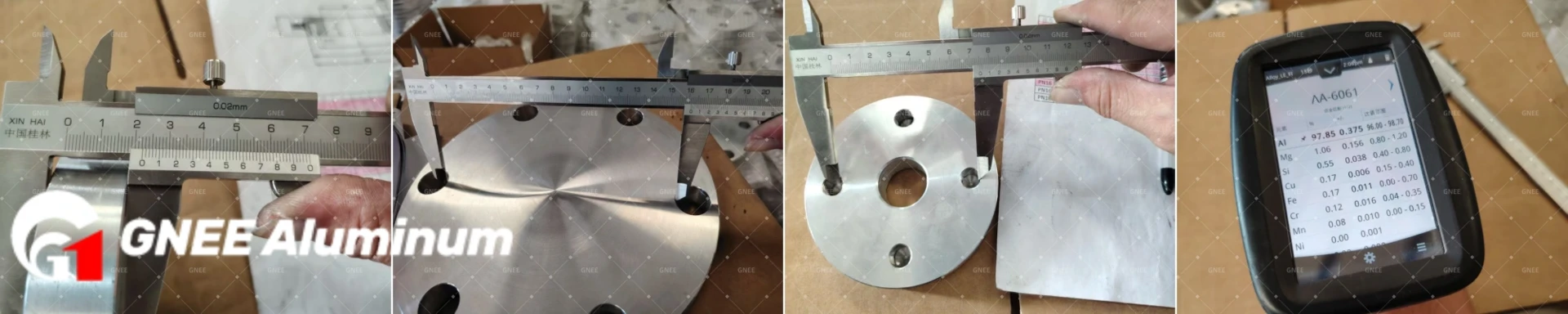
| EN 10204 3.1 report | Heat chemistry and mechanical results, traceable to the heat | That the finished flange is dimensionally compliant or rated |
| EN 10204 3.2 certificate | Results validated by the maker's inspection representative, independent of production, and by the buyer's representative or a regulation-designated inspector | That the material selection suits the medium |
| PMI | The delivered alloy matches the ordered grade | Mechanical properties or heat treatment |
| UT, RT, MT, PT | Internal or surface soundness to the stated acceptance level | Chemistry, rating or corrosion resistance |
| Charpy impact | Notch toughness at the test temperature | Room-temperature strength |
| Hardness survey | PWHT effect and sour-service compliance | Toughness or corrosion resistance |
| Ferrite content | The ferrite-austenite balance in duplex steel | Pitting or crevice resistance |
| ASTM G48 test | Localized corrosion resistance under the specified test conditions | Ferrite content or performance in another medium |
| Dimensional report and marking check | Dimensions, facing, bore and traceability marks | Pressure rating or mechanical results |
8. FAQ
Q: What materials are pipe flanges made of?
A: Carbon steel, stainless steel, Cr-Mo alloy steel, duplex and super duplex, aluminum, nickel alloy, plus cast iron and copper alloys for low-pressure services.
Q: How do I choose a flange material?
A: Fix pressure and temperature, read the rating table for the group, identify the corrosion mechanism, then confirm weight, pipe match and standard. Compare cost last. Table 9 is a first screen, not a final selection.
Q: Carbon steel or stainless?
A: Choose by medium, not by strength. A105 is fine for water, oil, gas and steam with coating or allowance. F316 is for chemicals, food, hot water and mild chloride. Neither is a marine grade.
Q: Are aluminum flanges as strong as steel?
A: No. A 6061-T6 forging has 260/240 MPa minimums against 485/250 MPa for A105, and about one third the stiffness. Aluminum is chosen for weight and dry, cool service. Its rating comes from B31.3 Appendix L or EN 1092-4, not from B16.5.
Q: Can 316L be used above 427°C?
A: Not under B16.5. F316L is in Group 2.3, which ends at 427°C. Use F316H or another group, or check the code that governs the project.
Q: Does a B16.5-pattern aluminum flange have a B16.5 rating?
A: No. B16.5 Table 1A does not list aluminum. Matching dimensions do not create a rating. State the rating route on the order.
Q: Can 5083-H116 be supplied to EN 1092-4?
A: No. EN 1092-4 lists EN AW-5083-O and EN AW-6061-T6, both to EN 12392. H116 is a B928 marine plate temper. It needs a design calculation or a project specification.
Q: What is the temperature limit for 5083 and 5086?
A: There is no single fixed number. Sensitization and intergranular corrosion depend on alloy, temper, temperature and exposure time. Assess the real duty; H116 and H321 reduce the risk but do not remove it.
Q: Is Inconel 625 good for 980°C?
A: That figure is an oxidation limit in clean air, not a pressure rating. For pressure duty, check allowable stress and creep in the governing code and confirm the medium.
Q: How does grade affect the pressure rating?
A: Grade sets the material group, and the group sets the allowable pressure at temperature. Changing grade can change the group. Read the table in the edition on the order; B16.5-2025 revised many values.
Q: Can I substitute one material for another?
A: Only after checking dimensions, pressure-temperature rating, corrosion and galvanic compatibility, code and owner acceptance, and the fabrication route. A matching bolt pattern is not a qualification.