

Vacuum equipment asks a lot of its materials. A chamber wall has to hold pressure from the outside, weld without leaks, keep its shape after machining, and release as little gas as possible once the pumps are running. Aluminum alloys meet a large part of that brief: they are light, they machine quickly, they conduct heat well, and they are not magnetic.
5083 aluminum is one of the alloys specified for welded vacuum structures. It is a non-heat-treatable Al-Mg alloy with 4.0–4.9% magnesium, it needs no post-weld heat treatment, and it holds toughness at cryogenic temperature.
The short version: 5083 is a good answer for welded shells, window frames, port structures and large plate work. It is not the alloy most vacuum chambers are machined from, and the vacuum performance of a finished part depends on machining, cleaning and welding as much as on the grade.
Request a Quote for 5083 Aluminum Plates
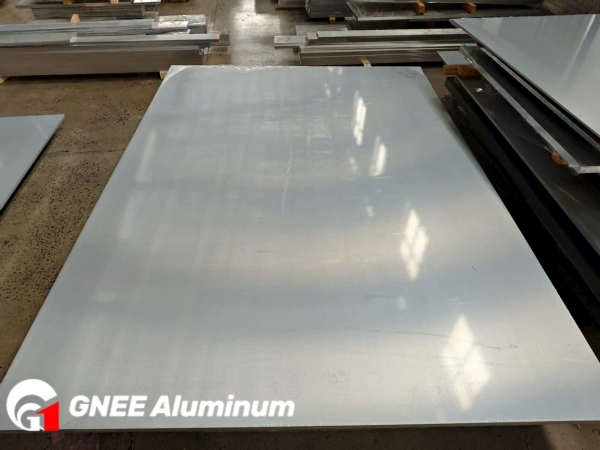
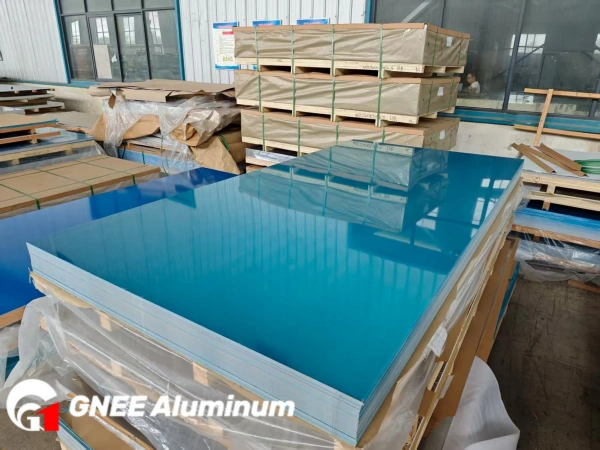
Aluminum Vacuum Chamber Material: Why 5083 Is Used in Vacuum Equipment
Stainless steel remains the default for many high-vacuum systems, and for good reasons: it is weldable, it tolerates bake-out at 200 °C and above, and the fabrication route is well understood. Aluminum earns its place where weight, machining time or thermal response matter more than the familiarity of steel.
Low Density and Easy Machining of Aluminum Vacuum Structures
5083 aluminum has a density of about 2.66 g/cm³ , against roughly 7.9 g/cm³ for 304 stainless steel. A chamber shell, a support frame or a large port structure weighs about a third as much in aluminum, which changes what the building structure and the handling equipment have to carry.
Machining is the other half of the argument. Aluminum cuts faster than stainless, tool wear is lower, and a roughing operation that takes hours in stainless steel takes a fraction of that in aluminum. For a component that starts as a thick plate and loses most of its mass to the milling cutter, the difference in machining cost is often larger than the difference in material price.
Thermal Conductivity of Aluminum Vacuum Chambers
5083 conducts heat at roughly 117 W/(m·K), and 6061-T6 at about 167 W/(m·K), against about 16 W/(m·K) for 304 stainless steel. Chamber walls that see radiant heat from a process, or that need to be cooled to a controlled temperature, move that heat through the wall far more readily in aluminum.
Low Magnetic Susceptibility of Aluminum in Vacuum Systems
Aluminum is non-ferromagnetic, with a magnetic susceptibility of the order of 10⁻⁵ - about three orders of magnitude weaker than the ferromagnetic response of carbon steel. It does not pull a magnetic field the way a ferritic part does, which matters in beam-line and instrument vacuum systems where the field has to stay undisturbed. Aluminum also activates less than steel under radiation, so a component can be handled sooner after shutdown.
Low susceptibility is not the same as a non-ferromagnetic assembly. Fasteners, inserts, seals and coatings bring their own materials, and the magnetic measurement is made on the finished part.
Design Limits of Aluminum in Vacuum: Expansion, Stiffness and Bake-Out
Three properties limit aluminum in vacuum service, and they sit at the centre of any aluminum vs stainless steel vacuum comparison:
Thermal expansion. 5083 expands at about 23.6 × 10⁻⁶/K, against roughly 17.3 × 10⁻⁶/K for 304 stainless steel. A welded aluminum structure moves more between assembly and operating temperature, and weld design has to absorb that movement.
Elastic modulus. Aluminum sits near 70 GPa, against about 193 GPa for stainless steel. Deflection under the same load is roughly three times larger, so stiffness comes from section design.
Bake-out temperature. Aluminum chambers are baked at lower temperature than stainless steel. The 5083 limit of about 65 °C applies to corrosive wet service - seawater, chlorides, condensation - where an electrolyte is present, and it is a corrosion limit. In vacuum the controlling effect is thermal: work hardening and residual stress relax from roughly 150 °C.
Those are two different mechanisms and they are often confused. In wet service the β phase (Mg₂Al₃) at the grain boundaries opens a corrosion path, and the 65 °C limit keeps the alloy outside the range where that path forms. In dry vacuum there is no electrolyte, so the sensitization route does not operate; what happens instead is thermal. Work hardening from rolling relaxes from roughly 150 °C, and at 250 °C for several hours the temper is effectively removed and residual stress is released. A 5083 part can be baked, and the bake cycle is agreed together with the temper. Stabilisation in H116 and H321 is about corrosion resistance, not about holding strength through a bake: at the same temperature and time both tempers lose the same work hardening, and a higher starting point does not change the proportion lost.
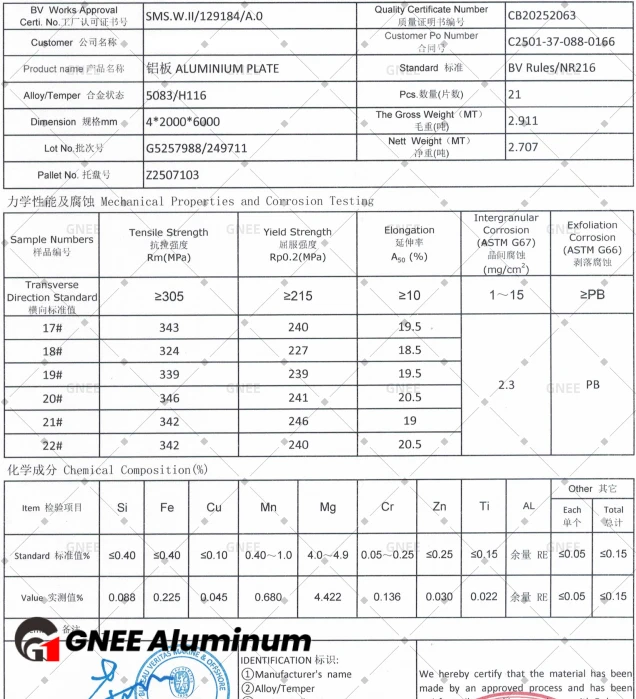
Chemical Composition of 5083 Aluminum
| Element | Content (%) | Function in 5083 |
|---|---|---|
| Mg | 4.0–4.9 | Solid-solution strengthening, corrosion resistance, weldability |
| Mn | 0.40–1.00 | Grain refinement, strength, strain-hardening response |
| Cr | 0.05–0.25 | Recrystallization control, stress-corrosion resistance |
| Si | ≤ 0.40 | Impurity, limited to protect weld corrosion resistance |
| Fe | ≤ 0.40 | Impurity, limited for ductility and surface quality |
| Cu | ≤ 0.10 | Kept low; copper would reduce corrosion resistance |
| Zn | ≤ 0.25 | Impurity |
| Ti | ≤ 0.15 | Grain refiner |
| Al | Remainder | Base metal |
As-Welded Joint Strength of 5083 Aluminum Against 6061
Welding is where 5083 separates itself from the heat-treatable alloys. 6061-T6 reaches about 310 MPa tensile strength in the parent metal, and a welded joint drops to roughly 165 MPa because the heat-affected zone loses the T6 aging. 5083 starts lower, at 303 MPa minimum and about 317 MPa typical, and an as-welded joint holds around 275 MPa. On a welded structure the two alloys end up close, and the 5083 joint needs no post-weld heat treatment.
That is the practical reason 5083 appears in welded chamber shells, frames and port structures: the design does not have to account for a soft weld zone or a furnace cycle the part cannot fit into.
Corrosion Resistance of 5083 Aluminum in Process Environments
5083 resists seawater, industrial atmosphere and many chemical exposures better than 6061 or the 7xxx alloys. The magnesium-rich surface forms a stable oxide film that re-forms when damaged. This matters in vacuum equipment that sees wet process gas, cleaning chemicals or condensate during maintenance, and it is the reason wet-process and cryogenic vessels are often built from 5xxx plate.
Cryogenic Toughness of 5083 Aluminum
5083 does not become brittle as temperature falls. Tensile strength rises slightly and elongation stays usable down to liquid-nitrogen and liquid-hydrogen temperatures, which is why the alloy appears in cryogenic vessels, cold traps and low-temperature test chambers. For vacuum systems that combine pumping with cryogenic panels, this is a design advantage that 6061 does not share to the same degree.
Aluminum Alloy Outgassing in Vacuum Service
Outgassing is the release of gas from the material and from everything on its surface once the chamber is pumped. It sets the base pressure a system can reach and the time it takes to get there, and it is the first technical question an engineer asks about any new material.
What Causes Outgassing in Aluminum Vacuum Components
Adsorbed water on the oxide surface, the largest single source in aluminum systems.
Hydrocarbon residues from machining coolant, handling and packaging.
Hydrogen dissolved in the metal, released slowly from the bulk.
Trapped gas in weld porosity, blind holes, crevices and lapped joints.
Contamination picked up in storage, transport and assembly.
Outgassing Data for 5083 Aluminum
| Material | H₂O rate (mbar·L·s⁻¹·cm⁻²) | H₂ rate (mbar·L·s⁻¹·cm⁻²) |
|---|---|---|
| 2050 aluminum | 3.95 × 10⁻⁸ (average on 2) | 2.47 × 10⁻¹⁴ |
| 2195 aluminum | No data | 2.99 × 10⁻¹³ |
| 2196 aluminum | 3.49 × 10⁻⁸ (average on 2) | 1.53 × 10⁻¹³ |
| RSA 501 | 3.31 × 10⁻⁹ | 3.19 × 10⁻¹² |
| RSA 905 | 1.93 × 10⁻⁹ | 1.56 × 10⁻¹² |
| 2219 aluminum | 9.52 × 10⁻⁹ | 4.28 × 10⁻¹⁴ |
| 5083 aluminum | 5.55 × 10⁻⁹ | 6.62 × 10⁻¹³ |
| Stainless steel | 3 × 10⁻¹⁰ | 3 × 10⁻¹² |
Read as a series, not as a material ranking. Each specimen reached the test with its own machining and surface-preparation history, and the source does not record those histories, so a difference between two entries cannot be attributed to the alloy. The hydrogen values also sit close to the lower limit the measurement resolves, which makes small separations between them inconclusive.
What the table supports is narrower than a material claim: within one laboratory and one pumping time, 5083 behaves like the other 5xxx and 2xxx alloys in the set, and the spread between entries shows how much surface condition moves the result.
Surface Treatment and Bake-Out for Aluminum Vacuum Structures
Three process choices move the outgassing number more than the choice between 5083 and another aluminum grade:
Machining without oil. Coolant and lubricant residues sit in the surface and release hydrocarbons for a long time. Alcohol-based machining, or machining without lubricant, is used for parts that will see vacuum service.
Cleaning and drying. Degreasing followed by a controlled dry, with the part kept under dry gas or vacuum until it is wrapped.
Bake-out. A vacuum bake at a temperature the alloy and the temper allow drives off adsorbed water. For 5083 the bake temperature is set by what the temper will tolerate: work hardening relaxes from roughly 150 °C, and a part that will later see wet service should also stay out of the sensitization range.
Anodizing is proposed as a surface improvement. For vacuum work, the porous anodic film holds water and adds its own bake-out load. Anodized 5083 is chosen for wear or chemical resistance, and its vacuum behavior is measured on the coated part.
Applications of 5083 Aluminum in Vacuum Equipment
5083 appears in vacuum systems where a welded, large or wet-service structure is needed. The list below separates the parts that sit inside the vacuum envelope from the structures that support the equipment from outside, because the two have different requirements.
GNEE supplies 5083 aluminum plate. Chambers, flange bodies and window frames are designed, welded and machined by equipment builders; the plate is the input, and the vacuum performance of the finished part is established by those operations.
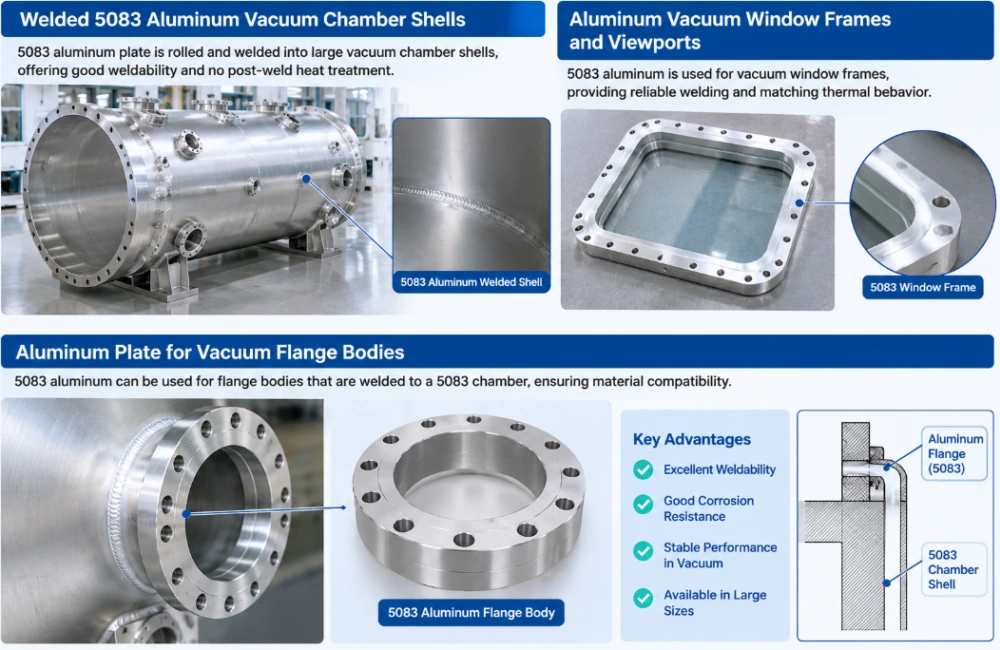
Welded 5083 Aluminum Vacuum Chamber Shells
Large chamber shells are rolled or formed from 5083 plate and welded into a closed body. The alloy is chosen for the weld: no post-weld heat treatment is needed, no precipitate forms in the heat-affected zone, and the plate is available in the widths that keep the number of longitudinal seams low. Shell thickness is set by external pressure, and the design has to account for the higher thermal expansion of aluminum.
Most 5083 aluminum plate for vacuum chamber manufacturing is ordered with the rolling direction, flatness tolerance and thickness allowance stated on the purchase order. A shell that has to be pulled into shape during welding carries stress that shows up later as distortion.
Aluminum Vacuum Window Frames and Viewports
A vacuum window is a thin membrane held in a frame. The membrane is usually fused silica, sapphire or a thin metal foil selected for pressure and radiation transmission, and the frame is machined or welded from plate. Aluminum plate for vacuum window frames is chosen for weldability and for matching the chamber material, so the frame and the chamber move together under thermal load.
The window as a component is designed, welded and leak-tested by the fabricator, and the plate is one input to it.
Aluminum Plate for Vacuum Flange Bodies
Flanges on aluminum vacuum systems are usually machined from 6061-T6 or 6082-T6, because they need a machined sealing groove, flatness and dimensional accuracy. 5083 appears in flange bodies that are welded to a 5083 shell, where matching the base metal matters more than machinability. Bolts, seals and gaskets are separate items with their own materials.
Supplying plate for a flange does not make the supplier a flange manufacturer, and the distinction matters when a buyer compares quotations.
Discuss Your Vacuum Chamber Material Requirements
Which 5083 Aluminum Plate Temper Fits Formed and Welded Vacuum Structures
Both tempers are supplied from the same alloy and both are non-heat-treatable. The difference is how much work the plate has seen and whether it has been stabilized, and that difference decides strength, formability and corrosion behavior.
| Temper | Tensile strength, min | Yield strength, min | Elongation, min | Where it fits |
|---|---|---|---|---|
| 5083 H111 sheet 0.2–6.3 mm | 275 MPa | 125 MPa | 16% | Formed covers, liners, lightly loaded sheet parts |
| 5083 H111 plate 6.3–80 mm | 270 MPa | 115 MPa | 14% | Formed and welded plate, window frames |
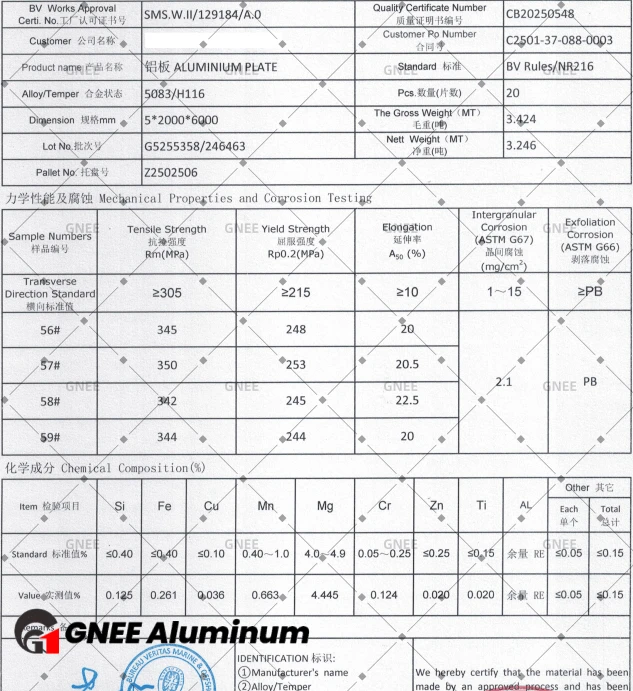
| 5083 H116 plate | 303 MPa | 214 MPa | 10–12% | Structural shells, wet service, cryogenic vessels |
H116 minima are 44 ksi / 31 ksi, written as 303 MPa and 214 MPa up to 38.1 mm; above that thickness the minima fall to 283 MPa and 200 MPa, and minimum elongation rises from 10% to 12% above 12.67 mm. H111 minima are 275 MPa for sheet 0.2–6.3 mm and 270 MPa for plate 6.3–80 mm. The mill certificate states the values for the delivered thickness.
5083 H111 Aluminum Plate: Soft, Formable and Easy to Weld
H111 is lightly work hardened from shaping and stays close to the annealed condition. Yield strength is 115 MPa for plate from 6.3 to 80 mm, elongation is 14%, and the plate bends, rolls and forms without the springback that a harder temper brings. A rolled shell or a formed bellows that has to take a radius is usually ordered in H111 or O, because the temper leaves the ductility the forming operation needs.
Higher-Strength Aluminum Plate Tempers for Structural and Wet Service
H116 is strain hardened and then thermally stabilized, a treatment developed for high-magnesium alloys to resist exfoliation and stress corrosion cracking. Minimum yield strength is 214 MPa and tensile strength 303 MPa (44 ksi / 31 ksi), and the temper is specified for marine plate, transport tanks and structural work in wet service.
In vacuum equipment it fits shells and frames that carry load and see moisture during cleaning or process. It is less formable than H111, so bend radii and roll diameters are planned around the temper. Most welded vacuum shells are ordered in O, H111 or H112, and H116 is chosen when the part also has to carry structural load or resist sensitization if it will later see wet service.
Choosing a 5083 Aluminum Temper for a Vacuum Component
Four questions settle the choice:
Is the part formed? A rolled shell or a bent frame favors H111 or O.
Does it carry structural load? Load-bearing shells and frames favor H116.
Does it see moisture or chemical exposure? Wet service favors H116, which is stabilized against exfoliation and stress corrosion.
What does the drawing and the standard say? The temper on the drawing has to exist in the standard that governs the delivery, and the certificate has to state it.
H111 and H116 are not interchangeable. Substituting one for the other changes minimum yield by roughly 90 MPa and changes the corrosion behavior of the part.
Fabrication Notes for 5083 Aluminum in Vacuum Service
A vacuum weld has to be sound and leak-tight, and aluminum is less forgiving than steel: hydrogen from moisture, oxide and contaminated filler shows up as porosity, and porosity shows up as a leak or a virtual leak. 5083 is welded with ER5183, ER5356 or ER5556 filler to AWS A5.10, and ER4043 is generally avoided because its silicon combines with the magnesium in the base metal to form Mg₂Si in the weld. Aluminum expands about 23.6 × 10⁻⁶/K and conducts heat away quickly, so fixturing and weld sequence are planned before the first seam, and the fabricator leak-tests the finished joint, usually by helium mass spectrometry.
Specification of 5083 Aluminum Alloy Plate
The standard on the drawing sets the chemistry, the mechanical minima and the tolerances, and it has to match the product form. Plate is not covered by the extrusion or tube standards, and a certificate that cites the wrong standard is a problem regardless of the metal quality.
ASTM and EN Standards for 5083 Aluminum Plate
| Standard | Scope for 5083 |
|---|---|
| ASTM B209/B209M | Aluminum sheet and plate, including 5083 in O, H111, H112, H116, H321 |
| ASTM B928/B928M | High-magnesium sheet and plate for marine service; the route for H116 and H321 |
| EN 485-2 | Mechanical properties of sheet, strip and plate |
| EN 573-3 | Chemical composition and designation, EN AW-5083 / AlMg4.5Mn0.7 / 3.3547 |
| JIS H4000 | Aluminum sheets, strips and plates; alloy A5083P |
| GB/T 3880 | Chinese general-purpose aluminum sheet and plate |
JIS H4000 A5083P and 5083 Aluminum Tempers
JIS H4000 lists the alloy as A5083P. Its temper table is written in the JIS system, while the H111 and H116 designations used throughout this article come from the ASTM and Aluminum Association system. A drawing that asks for "JIS H4000 5083-H111" pairs a Japanese product standard with an American temper designation, and the two have to be reconciled before the plate is ordered.
Two workable routes exist. The first states the alloy to JIS H4000 as A5083P and the temper to ASTM B209 as H111, with both named on the certificate. The second accepts H32 where the higher strength of a work-hardened and stabilized temper suits the part. Which route applies is a design decision, and it belongs with the engineer who wrote the drawing.
Mill Certificates for 5083 Aluminum Plate
An EN 10204 3.1 mill certificate states the chemistry and mechanical properties of the delivered heat, and it is the document a fabricator passes to its own customer. Type 3.2 inspection, which involves independent witnessing, can be arranged on request. The certificate has to name the alloy, the temper and the standard the plate was made to, and those three have to match the drawing.
Buying 5083 Aluminum Plate for Vacuum Equipment
5083 aluminum plate for vacuum equipment components is confirmed on a short list, and each item is a question the supplier should be able to answer before the order is placed.
5083 Aluminum Alloy, Temper and Dimension Checks
Alloy designation written the same way on the drawing, the order and the certificate: 5083, EN AW-5083 or A5083P.
Temper available in the named standard, and stated on the certificate.
Thickness, width and length inside the ordered tolerance, with the measuring method agreed.
Flatness stated with the measuring length and the support condition, because a flatness figure without them cannot be checked.
Machining allowance added to the ordered thickness where the part is milled after delivery.
Surface Condition and Cleanliness of 5083 Aluminum Plate
Vacuum work is sensitive to surface condition in a way that structural work is not. Scratches, roll marks, oxide patches, edge cracks and embedded contamination all become cleaning problems later, and a plate that arrives with coolant residue on it has already started the outgassing clock.
Useful questions for a supplier: is the plate machined or mill finish, is a protective film applied, is the film removable without adhesive residue, and is the plate packed dry. For vacuum-destined plate, the answers belong in the purchase order.
Packing and Documentation for 5083 Aluminum Plate
Aluminum plate for vacuum equipment travels as sea freight in most export orders, and the packing has to keep moisture away from the surface. Seaworthy crates on fumigated timber, waterproof paper, desiccant and interleaving between plates are the standard measures. The documents that travel with the plate are the mill certificate, the packing list and the certificate of origin where the destination requires one.

About GNEE
GNEE has supplied aluminum products since 2008 and exports to 100+ countries and regions.
5083 plate is available in O, H111, H112, H32, H116 and H321, cut to size or supplied as full plate.
Processing includes sawing, shearing and cut-to-size work, with thickness, width and length confirmed against the order before production.
EN 10204 3.1 mill certificate with each lot; 3.2 and third-party inspection (SGS / BV / TÜV) can be arranged on request.
Get Custom 5083 Aluminum Plate Solutions
FAQ
Which aluminum alloy is used for vacuum chamber bodies and welded shells?
The question is settled by the part. Plate that is machined into a chamber body needs a stress-relieved temper that machines cleanly and holds a tight surface finish. Plate that is rolled and welded into a shell needs formability and a weld that needs no post-weld heat treatment. 5083 serves the second case.
Does 5083 aluminum outgas less than stainless steel?
It depends on the gas and the surface. CERN's 2017 vacuum surfaces and coatings seminar reports measurements, attributed to P. Lepeule and M. Morrone, in which water vapour dominates the first hours of pumping and hydrogen release stays far lower. Aluminum holds water on its oxide, so drying, machining practice and bake-out move the result more than the choice of alloy. The figures and their test conditions are set out in the outgassing section above.
Can 5083 aluminum be used in ultra-high vacuum?
The alloy does not set the vacuum level. 5083 plate appears in high-vacuum systems as shells, frames and bellows that sit outside the process zone or that do not take part in the full bake cycle of the chamber interior. On any part, ultra-high vacuum depends on the surface being machined, cleaned and baked and the weld quality being verified by leak testing. Surface preparation, weld soundness, joint design and the cleaning route decide what a component reaches, and those steps belong to the fabricator of the chamber.
Does the 5083 aluminum plate temper matter for a vacuum component?
Yes. The temper sets how the plate forms, how much load it carries and how it behaves in wet service, and a component drawing has to name one. H111 is lightly work hardened from shaping and stays close to annealed condition, with minimum yield strength of 115 MPa for plate 6.3 to 80 mm thick. H116 is strain hardened and thermally stabilized for magnesium alloys, with minimum yield strength of 214 MPa from 1.60 to 38.10 mm and 200 MPa from 38.11 to 76.20 mm, and resistance to exfoliation and stress corrosion. H111 forms and welds more easily; H116 carries more load and suits wet service. They are not interchangeable on a drawing.
Does anodizing improve the vacuum performance of 5083 aluminum?
Anodizing usually makes outgassing worse. The porous anodic film holds water and needs a long bake before it stops releasing it. Anodizing is chosen for chemical resistance or wear, and vacuum surfaces are normally left bare, machined and cleaned. Where a coating is required, the vacuum performance has to be measured on the coated part.
Can 5083 aluminum be supplied in T6 temper?
No. 5083 is a non-heat-treatable Al-Mg alloy, so T6 and T651 do not apply to it. Its strength comes from magnesium in solid solution and from strain hardening, and it is supplied in O, H111, H112, H32, H116 and H321. A drawing that specifies 5083-T6 has a conflict that has to be resolved before the plate is ordered.