

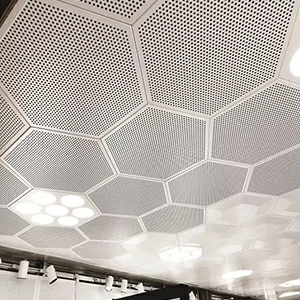
GNEE supplies perforated aluminum sheets used as ceiling infill and finished ceiling panels in architectural and commercial projects. A perforated aluminum ceiling panel is a flat aluminum sheet punched or CNC-cut with a regular hole pattern; it is the material layer, not a complete suspended ceiling system with grids, hangers and acoustic packs. Choosing the right panel means matching alloy, thickness, hole pattern, open area, edge detail and surface finish to the location and installation type. We cover the selection parameters below and discuss custom supply against your drawing.
What Are Perforated Aluminum Ceiling Panels?
Structure of a Perforated Aluminum Ceiling Panel
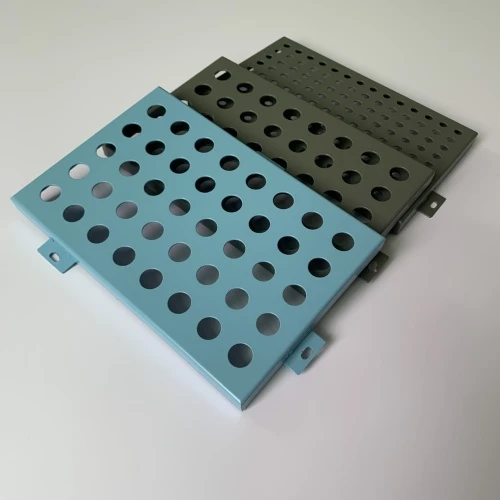
A panel has three functional zones: the perforated field (the patterned hole area), the unperforated edge margin (left solid so panels frame and align on site), and any folded edge or flange that seats the panel into the suspension system. The base is aluminum sheet; perforation removes metal, so stiffness and flatness are judged on the finished perforated panel, not the plain sheet.
Why Use Aluminum for Perforated Ceiling Panels?
Aluminum is chosen for its low weight, atmospheric corrosion resistance, good formability and receptive surface for anodizing or coating. Versus steel it keeps the ceiling light and avoids rust in humid interiors; versus solid panels it adds airflow, light passage and acoustic options through the open area. GNEE supplies the panel material and custom perforation, not the finished ceiling-system installation.

Recommended Aluminum Alloys for Perforated Ceiling Panels
Ceiling panels are normally made from non-heat-treated 3xxx and 5xxx alloys, with 6xxx reserved for special engineering cases. The table gives indicative properties; exact alloy, temper and stock are confirmed per order.
| Alloy / temper | Series | Density (g/cm³) | Indicative tensile (MPa) | Recommended positioning |
|---|---|---|---|---|
| 3003-H14 / H24 | Al-Mn (3xxx) | 2.73 | ~140-180 | General architectural ceilings; workhorse for formed and acoustic panels |
| 3005 / 3105 | Al-Mn-Mg (3xxx) | 2.73 | ~150-200 | Building coated-sheet and ceiling projects; chosen per coating and forming route |
| 5005-H34 | Al-Mg (5xxx) | 2.70 | ~145-185 | Anodized decorative panels where color consistency matters |
| 5052-H32 / H34 | Al-Mg (5xxx) | 2.68 | ~210-260 | Projects needing higher strength or corrosion resistance |
| 6061-T6 | Al-Mg-Si (6xxx) | 2.70 | ~310 | Special engineering requirements; not the routine thin-ceiling default |
3003 Aluminum Alloy for General Ceiling Applications
3003 (Al-Mn) has good formability and moderate strength, so H14 and H24 are widely used for general and acoustic ceiling panels; H14 is strain-hardened, H24 strain-hardened then partially annealed.
3005 and 3105 Aluminum Alloys for Architectural Ceilings
3005 and 3105 (Al-Mn-Mg) are common in building coated-sheet and ceiling products, chosen for a coated-sheet spec or slightly higher strength than 3003. Temper is confirmed per coating and project.
5005 Aluminum Alloy for Anodized Ceiling Panels
5005 (Al-Mg) anodizes to a stable, even metallic tone, favored where a consistent anodized look is required. A sample is confirmed before volume anodized production.
5052 Aluminum Alloy for Specific Project Requirements
5052 (Al-Mg) gives higher strength and corrosion resistance than 3003 or 5005 for stricter-performance projects; its higher strength also raises forming force and springback.
Is 6061-T6 Suitable for Perforated Aluminum Ceiling Panels?
6061-T6 is heat-treated and high-strength; usable where structural performance is specified, but its cost and forming difficulty make it the exception rather than the routine thin-ceiling choice.
Thickness and Dimensions of Perforated Aluminum Ceiling Panels
Typical Thickness for Aluminum Ceiling Panels
The market-reference bands below come from common ceiling-product practice, not a GNEE fixed standard. Actual thickness follows panel size, open area, support spacing and installation type, confirmed per drawing.
| Thickness band | Positioning | Note |
|---|---|---|
| 0.4-0.5 mm | Light panel reference | Confirm stiffness and support condition |
| 0.6-0.8 mm | Regular selection focus | Matches widely used market specifications |
| 0.9-1.0 mm | Thicker panel option | Watch weight, stiffness and edge processing |
| 1.2 mm | Special-project reference | Combine with panel size and mounting method |
| 1.5 mm and above | Engineering custom direction | Structural assessment required |
Factors Affecting Panel Thickness and Dimensions of Aluminum Ceiling Panels
Thickness and size are set together by panel length and width, hole diameter and pitch, open area, edge width, folded edge, support spacing and installation type. Larger panels or higher open area push thickness up to avoid sagging; we confirm the combination against the drawing rather than a single global number.
Have target dimensions? Send Your Required Panel Dimensions
Perforation Patterns for Aluminum Ceiling Panels
Round Hole Perforated Aluminum Ceiling Panels
Round holes are the most common ceiling pattern, giving uniform airflow and the highest residual strength for a given open area. They follow DIN 24041 codes (Rv staggered, Rg straight, Rd diagonal).
Square Hole Perforated Aluminum Ceiling Panels
Square holes (Qv/Qg) deliver a modern grid look and higher open area than round at the same pitch, used where a bolder visual and stronger ventilation are wanted.
Slotted Perforated Aluminum Ceiling Panels
Slotted (oblong) holes (Lv/Lg) give a linear, directional texture common in feature ceilings and baffle screens. Custom slot lengths and orientations are reviewed per drawing.
Decorative and Custom Perforation Patterns of Aluminum Ceiling Panels
Beyond standard geometries, custom decorative patterns - logos, gradients, architectural motifs - are produced to drawing. Custom-pattern tooling and feasibility are confirmed per inquiry.


Open Area, Hole Diameter and Pitch of Aluminum Ceiling Panels
What Is Open Area in Perforated Aluminum Ceiling Panels?
Open area is the percentage of the perforated zone occupied by holes, calculated for the perforated field only; the unperforated edge margin is excluded. It drives visual transparency, airflow and residual stiffness, and is distinct from acoustic absorption.
How Hole Diameter and Pitch Affect Open Area of Aluminum Panels
Open area rises as hole diameter increases and as pitch (center distance) decreases. For round holes on a 90° straight grid: OA = 78.54 × (d/p)². For a 60° staggered layout: OA = 90.69 × (d/p)², giving more open area for the same d and p. These formulas apply only to the stated round-hole arrangements; square, slotted and decorative patterns use their own geometry.
How to Select Open Area for Aluminum Ceiling Applications
Choose the lowest open area that meets the visual, airflow or acoustic target, so the panel stays rigid and flat. Open area is balanced against strength and span, and is calculated from your agreed hole diameter and pitch. For a calculation walkthrough, see the Perforated Aluminum Sheet Open Area Calculation guide.

Surface Finishes for Perforated Aluminum Ceiling Panels
Mill Finish for Aluminum Ceiling Panels
Mill finish is the as-rolled surface, used where the panel is concealed or will be further processed. It is the lowest-cost option and the base for later coating or anodizing.
Powder Coating for Perforated Aluminum Panels
Powder coating gives a uniform colored film in any RAL color; double-sided application and full edge coverage matter on perforated parts. Perforating before coating keeps hole walls covered; coating-then-perforating exposes bare edges. Color, film thickness and weatherability are confirmed per project.
Anodizing for Perforated Aluminum Ceiling Panels
Anodizing builds a protective oxide layer with a consistent metallic tone (natural, champagne, bronze directions). On perforated edges the finish must read evenly, so sample confirmation is recommended for anodized decorative work.
PVDF Coating for Perforated Aluminum Ceiling Panels
PVDF (fluoropolymer) coating is used where long-term exterior color stability is required, such as soffits and building exteriors. It differs from powder coating in durability and cost; the coating system is selected against the project environment.


Applications of Perforated Aluminum Ceiling Panels
Perforated Aluminum Ceiling Panels for Commercial Offices
Offices use lay-in and clip-in panels where specifiers care about dimension consistency, open area for air return and a clean finished look. Acoustic backing is often specified with the panel.
Perforated Aluminum Ceiling Panels for Airports and Transportation Buildings
High-traffic buildings need large-format consistency, durable finishes and integration with lighting and HVAC. Panel flatness and batch color consistency are the main purchasing concerns.
Perforated Aluminum Ceiling Panels for Shopping Malls and Retail
Retail ceilings favor decorative patterns and brand-matched colors, with cutouts for lighting, speakers and signage coordinated to the panel layout.
Perforated Aluminum Ceiling Panels for Industrial and Commercial Facilities
Facilities prioritize function: ventilation, service access and robust finishes. Mill or simple coated panels are common, with practical open area for air movement.

Panel Formats and Ceiling Installation Types for Aluminum Ceiling Panels
Lay-in Perforated Aluminum Ceiling Panels
Lay-in tiles rest on the grid and are the most common modular format (e.g., 600 × 600 mm). Edge and flatness must suit the grid; cutting and edge requirements are confirmed per drawing.
Clip-in Perforated Aluminum Ceiling Panels
Clip-in panels lock to concealed carriers for a seamless look. They need precise edge folding and dimension control so panels seat and release correctly.
Hook-on Perforated Aluminum Ceiling Panels
Hook-on panels hang on visible or concealed rails, common for large-format and open-ceiling designs. Fixing-point positions and panel rigidity are planned with the system drawing.
Custom Panel Edges and Cutouts of Aluminum Ceiling Panels
Folded edges, flanges, fixing holes and service cutouts are defined by the ceiling-system drawing. GNEE supplies panels processed to that drawing.
Submit your drawing. Submit Your Drawing for a Specification Review
Other Perforated Metal Materials Available
In addition to perforated aluminum sheets, GNEE can also assist with the supply of other perforated metal materials, including stainless steel, carbon steel and copper, subject to material availability and project requirements. Buyers can submit their material specifications, panel dimensions and perforation drawings for supply assessment.
Stainless Steel Perforated Sheets Versus Aluminum Panels
Stainless steel (304, 316) offers high corrosion resistance for aggressive or coastal interiors, at higher weight and cost. It is specified where the environment or design calls for.
Carbon Steel Perforated Sheets Versus Aluminum Panels
Carbon steel and galvanized steel are the lower-cost option for commercial and industrial ceilings where weight is not a constraint and coating maintenance is acceptable.
Copper Perforated Sheets as an Alternative to Aluminum Panels
Copper is used for distinctive architectural finishes.
Quality Inspection, Packaging and Delivery of Perforated Aluminum Ceiling Panels
Material and Dimensional Inspection of Aluminum Ceiling Panels
Inspection covers alloy and temper, sheet thickness and dimensions, hole diameter, pitch and arrangement, panel flatness, surface finish and edge quality. ASTM B209 / B209M defines the base aluminum sheet material; it is not a complete finished perforated ceiling-panel standard, so hole diameter, pitch, open area, edge detail and processing tolerances are agreed separately per order.
Packaging for Perforated Aluminum Ceiling Panels
Panels are protected with surface film, separated by spacers, and packed on pallets or in wooden cases with moisture-proof wrapping for export. Packaging is matched to panel size and finish to prevent edge damage and transit corrosion.
Quality Documents and Delivery of Aluminum Ceiling Panels
Available documents may include EN 10204 3.1 MTC and inspection reports.Related standards: ASTM B209/B209M (aluminum sheet), EN 485 series (delivery conditions and tolerances, by part), EN 1396 (coil-coated aluminum strip; scope to confirm for perforated panels), EN 13964 (suspended ceilings - performance and test requirements).

Commercial Terms for Perforated Aluminum Ceiling Panels
| Term | GNEE standard |
|---|---|
| MOQ | Flexible - small trial orders and large-volume orders both accepted |
| Lead time | 15-30 days (confirmed after RFQ review) |
| Pricing | Quoted per order against the SMM (Shanghai Metals Market) aluminum price plus processing |
| Inspection | EN 10204 3.1 MTC; 3.2 and third-party inspection on request |
| Standards | Base material ASTM B209 / EN 485; chemistry EN 573-3; hole codes DIN 24041 |
| Response | Quotation review replied within 24 hours of complete RFQ |
About GNEE
Henan GNEE New Material Co., Ltd has supplied aluminum products since 2008 and serves 100+ countries. For ceiling and perforated-panel projects we supply aluminum sheet material and custom perforated panels processed to customer drawings, with flexible MOQ and a typical 15-30 day lead time. Material traceability and EN 10204 3.1 documentation are provided; processing steps, capacities and certificates are confirmed per inquiry. Related supplied alloys: 3003-H24, 5005-H34, 5052 and 6061-T6 perforated aluminum sheet.

FAQ about Perforated Aluminum Ceiling Panels
Which Aluminum Alloy Should I Choose for Perforated Ceiling Panels?
For general ceilings, 3003-H14 or H24 is the workhorse, with 3005 and 3105 on coated building-sheet projects; 5005-H34 for a consistent anodized look, 5052-H32/H34 for extra strength or corrosion resistance, and 6061-T6 reserved for special engineering needs.
What Thickness Is Commonly Used for Perforated Aluminum Ceiling Panels?
Market references cluster at 0.6-0.8 mm for regular ceilings, 0.4-0.5 mm for light panels (stiffness must be confirmed) and 0.9-1.2 mm or more for larger spans or engineering custom work; actual thickness follows panel size, open area, support spacing and installation type.
What Are the Common Sizes of Perforated Aluminum Ceiling Panels?
Modular references such as 600 × 600 mm and 600 × 1200 mm are widely used in lay-in and clip-in systems, with custom dimensions supplied to drawing; GNEE confirms sizes, edges and tolerances against the project specification.
How Does Open Area Affect Perforated Aluminum Ceiling Panels?
Open area is the share of the perforated zone that is hole. Higher open area increases light, air and transparency but reduces residual stiffness; it is not the same as sound absorption, and is balanced against strength, span and the visual brief.
Can Perforated Aluminum Panels Be Used with Lay-in or Clip-in Ceiling Systems?
Yes, where the panel format, edge detail and cutouts match the suspension system; lay-in, clip-in and hook-on each place different demands on edge folding, fixing points and cutouts. GNEE supplies panels to the ceiling-system drawing; final assembly is done by the installer.
Do Perforated Aluminum Ceiling Panels Improve Acoustic Performance?
Perforation alone does not set acoustic performance; a perforated face panel contributes only with acoustic backing and a rear cavity, and the measured result depends on that full assembly. Specific absorption values require tested backing and assembly data, confirmed per project.
Can You Supply Stainless Steel or Copper Perforated Sheets?
Beyond perforated aluminum, GNEE can assist with stainless steel, carbon steel and copper perforated sheets, subject to availability and project requirements. Buyers submit material specification, dimensions and perforation drawing for a supply assessment; grades, thicknesses and processing are confirmed per inquiry.