


Henan Gnee New Material Co., Ltd. is one of the most reliable manufacturers and suppliers of 3003 H24 Perforated Aluminum Sheet in China. With abundant experience, we warmly welcome you to wholesale high quality 3003 H24 Perforated Aluminum Sheet in stock here from our factory. Good service and reasonable price are available.
As a 3003 H24 perforated aluminum sheet supplier and manufacturer, GNEE reviews customer drawings and confirms material and processing requirements against available production capabilities. Send a CAD, PDF or DXF drawing, or just describe the application.
Request a quote & Send your drawing
3003 H24 Perforated Aluminum Sheet Overview
A 3003 H24 perforated aluminum sheet starts as solid 3003 aluminum-manganese alloy sheet or plate in the H24 temper. Regular openings - round, square, slotted, hexagonal or custom - are formed by perforating, so the panel keeps a continuous aluminum body while gaining controlled openings. Unlike a commercially pure grade such as 1060, 3003 is chosen for the balance of moderate strength, good formability and good corrosion resistance that the Al-Mn chemistry provides. Because perforation reduces the cross-section, the finished panel's performance depends on thickness, hole size, pitch, arrangement, support and load - not on the base alloy alone. GNEE supplies the 3003 H24 base material and performs the perforation and follow-up processing to the drawing.
| Product | Material | Main characteristics |
|---|---|---|
| 3003 H24 aluminum sheet (plain) | 3003, H24 temper | Solid Al-Mn sheet; base material before perforation |
| 3003 H24 perforated aluminum sheet | 3003, H24 temper | Controlled openings for airflow, screening and visual transparency |
| 3003 H24 perforated aluminum panel / plate | 3003, H24 temper | Cut-to-size perforated sheet or plate for architectural and industrial use |
H24 is the material temper, not a hole pattern or a surface treatment. Keep 3003 H24 distinct from plain 3003 and from other tempers such as H14 or O.

Why Choose 3003 H24 Aluminum for Perforated Sheets?
3003 belongs to the 3xxx series of non-heat-treatable aluminum alloys, with manganese as the principal alloying element. Its value for perforated sheet comes from the combination of moderate strength, good formability and good corrosion resistance - not from high strength. The points below explain where 3003 H24 fits relative to other alloys and where a different grade should be considered.
Aluminum-Manganese Alloy Composition of 3003 Aluminum
3003 is an Al-Mn alloy (about 1.0–1.5% manganese as the main alloying addition, with small controlled limits on silicon, iron, copper and zinc). Compared with commercially pure 1060, the manganese addition raises strength while keeping the alloy workable and weldable. The exact composition is verified against the specified material standard.
Strength and Temper Characteristics of 3003 H24 Aluminum
3003 is non-heat-treatable, so its strength comes from strain hardening. In the H24 temper the sheet is hardened to roughly the 1/2-hard condition and then partially annealed (stabilized), giving a more stable temper than H14 at a similar strength level. Typical indicative values for 3003-H24 base (unperforated) material are about 150–200 MPa tensile and 110–150 MPa yield depending on thickness; guaranteed minimums are stated on the EN 10204 3.1 MTC. Perforation removes load-carrying cross-section, so the finished panel's strength is lower and must be evaluated for the actual geometry.
Formability and Perforation Considerations for 3003 H24 Aluminum
3003 H24 offers a useful balance of strength and formability, which helps during punching and subsequent bending or shaping. The achievable hole size, pattern, minimum ligament width and post-perforation flatness still depend on thickness and temper, so the processing route is confirmed against the drawing rather than assumed. For parts that will be bent after perforation, the bending radius, bend direction and hole-edge position are reviewed together.
Corrosion Resistance and Application Suitability of 3003 H24 Aluminum
3003 generally gives good corrosion resistance in many atmospheric environments, which is one reason it is used for exterior decorative and ventilation panels. The actual durability depends on the environment, the surface finish and the detailing (drainage, edge protection, contact with dissimilar metals). For aggressive marine or industrial exposure, the finish and design should be confirmed for the specific condition.
| Material | Main selection consideration |
|---|---|
| 1060 | High aluminum content and electrical/thermal properties where purity and conductivity matter |
| 3003 H24 | Aluminum-manganese alloy; balance of strength, formability and corrosion resistance |
| 5052 | Higher strength and good corrosion resistance for more demanding applications |
| 5005 | Often considered where architectural surface appearance and anodizing are important |
The table compares material-positioning factors, not a guaranteed strength difference at any given thickness and temper. Confirm properties against the applicable standard and the MTC.
3003 H24 Perforated Aluminum Sheet Specifications
| Parameter | Options / Details |
|---|---|
| Product | 3003 H24 perforated aluminum sheet / 3003 H24 perforated aluminum plate / 3003 H24 perforated aluminum panel |
| Aluminum alloy | 3003 (Al-Mn, 3xxx series) |
| Temper | H24 (strain-hardened and partially annealed; other tempers such as H14 / O available on request) |
| Thickness | 0.5–6.0 mm typical for panel work (plate sizes fixed from drawing) |
| Sheet width | 1000 / 1220 / 1250 / 1500 mm typical; other widths by arrangement |
| Sheet length | 2000 / 2440 / 3000 mm typical, or cut to length |
| Hole shape | Round / Square / Slotted / Hexagonal / Custom |
| Hole diameter | From ~0.5 mm upward; minimum practical diameter relates to sheet thickness |
| Hole pitch | Center-to-center distance, set per drawing (typical pitch ≥ hole diameter) |
| Hole arrangement | 60° Staggered / 90° Straight / 45° Staggered / Custom |
| Open area | Up to ~60% depending on hole geometry (calculated from d and p) |
| Edge margin | 10–20 mm typical, subject to drawing and tooling |
| Surface finish | Mill finish / Anodized / Powder coated / PVDF / Brushed |
| Standard | ASTM B209/B209M, EN 485, GB/T 3880 (confirm against the order) |
| Processing | Perforating, cutting, deburring, leveling and surface finishing |
The values above are typical reference ranges for the product family; the exact alloy, temper, thickness, dimensions, hole geometry and tolerances are fixed from the drawing and production review.
Hole Patterns for 3003 H24 Perforated Aluminum Sheet
A 3003 H24 aluminum sheet with holes can be produced in several geometries. Each pattern serves a different buying purpose; the achievable pattern is confirmed against available tooling and the drawing.
Round Hole Pattern on 3003 H24 Aluminum Sheet
The most common pattern for a 3003 H24 aluminum round hole sheet. Round holes suit general ventilation, screening and decorative use, and the open area is easy to calculate from diameter and pitch.
Square Hole Pattern on 3003 H24 Aluminum Sheet
Square holes give a regular geometric appearance and defined openings, used where a uniform grid look or a specific opening shape is required.
Slotted (Oblong) Hole Pattern on 3003 H24 Aluminum Sheet
Slotted holes provide elongated openings for directional airflow and a distinctive visual line. The open area is calculated from slot width, length and the two pitch directions.
Hexagonal Hole Pattern on 3003 H24 Aluminum Sheet
A hexagonal layout offers an alternative visual pattern and an efficient open-area distribution for screening and decorative panels.
Custom Hole Patterns for 3003 H24 Aluminum Sheet
Project-specific patterns - combined geometries, gradients or logos - are reviewed from the drawing. Provide the hole map or a clear description; GNEE confirms manufacturability against tooling.

Open Area and Hole Spacing of 3003 H24 Perforated Aluminum Sheet
Open area is the percentage of the sheet surface occupied by holes. A higher open area leaves less solid material, so the suitable thickness should be evaluated together with hole diameter, pitch, ligament width, panel dimensions and support conditions. A higher open area does not by itself indicate that a specific thickness is suitable for every application.
How to Calculate Open Area of Perforated Aluminum Sheet
Open area is the total hole area divided by the total sheet area, expressed as a percentage:
Open Area (%) = (Σ hole area ÷ sheet area) × 100
For regular, same-diameter round holes:
60° staggered: OA (%) = 90.69 × (d / p)²
90° straight: OA (%) = 78.54 × (d / p)²
where d = hole diameter and p = center-to-center pitch. These formulas apply to ideal repeating patterns; panels with solid margins, non-perforated zones or irregular spacing are calculated from the actual perforated area.
| d (mm) | p (mm) | Arrangement | Open area (calc.) | Note |
|---|---|---|---|---|
| 2 | 4 | 60° staggered | 22.7% | Calculation example |
| 3 | 5 | 60° staggered | 32.7% | Calculation example |
| 4 | 6 | 60° staggered | 40.3% | Calculation example |
| 5 | 8 | 60° staggered | 35.4% | Calculation example |

Hole Diameter and Pitch of Perforated Aluminum Sheet
Three terms define a hole layout:
Hole diameter (d): the diameter of a single hole.
Pitch (p): the center-to-center distance between two adjacent holes - measured from hole center to hole center.
Ligament width: the minimum solid metal width between adjacent holes; often expressed as pitch minus diameter, but the minimum in every direction is confirmed from the drawing.
Ligament Width and Edge Margin of Perforated Aluminum Sheet
Ligament width is the remaining metal between holes; edge margin is the unperforated border along the sheet edges. Both depend on hole diameter, thickness, pattern and tooling, and are confirmed during the drawing and manufacturing review, not assumed.
How Open Area Affects Panel Stiffness of Perforated Aluminum Sheet
A higher open area reduces both the remaining material and the ligament width, which lowers the panel's stiffness and changes how it behaves under load and during forming. For 3003 H24 aluminum sheet, the final thickness and perforation layout should be assessed together with hole diameter, pitch, ligament width, panel dimensions and support conditions. The flatness after perforation and any later bending also tie back to these same parameters.
Manufacturing Process for 3003 H24 Perforated Aluminum Sheet
GNEE provides the full processing chain for custom 3003 H24 perforated aluminum sheet: base-material selection, cutting, perforating, deburring, leveling, inspection and surface finishing. Provide the drawing and GNEE confirms the layout, cut size and finish as part of the order. Specific equipment, tooling limits and maximum dimensions are confirmed per project.
3003 H24 Base Sheet Preparation for Perforated Aluminum
The base 3003 H24 aluminum sheet or plate is verified for alloy and temper and cut to the starting size before perforation. Confirm the base material standard (ASTM B209/B209M, EN 485 or GB/T 3880) so the certificate matches the order.
Mechanical and CNC Punching of 3003 H24 Aluminum Sheet
Regular patterns are produced by CNC or mechanical punching using dies matched to the hole shape and pitch. For 3003 H24, hole size versus sheet thickness, ligament width and margins are checked for manufacturability before production; the H24 temper's stability helps control flatness through the process.
Laser Cutting of 3003 H24 Aluminum Sheet
Laser cutting is used where fine holes, complex outlines or custom patterns fall outside standard punching tooling. Confirm achievable minimum hole size and edge quality for the chosen thickness.
Deburring and Edge Finishing of Perforated Aluminum Sheet
Perforating can leave burrs on the die side and may cause panel bowing. Deburring and roller leveling restore edge quality and flatness; state your acceptance limits for burr height and flatness deviation on the technical query.
Sheet Leveling and Cut-to-Size Processing of Perforated Aluminum Sheet
Leveling and cut-to-size processing are provided as part of the order. State the required cutting method, maximum processed dimension and dimensional tolerance so GNEE can confirm the achievable limits for your order.


Surface Finishes for 3003 H24 Perforated Aluminum Sheet
3003 H24 accepts the common aluminum finishes, but the achievable appearance depends on the temper and the processing sequence (pre- vs post-perforation). The finish route, film thickness and hole-edge appearance are confirmed per order.
Mill Finish on 3003 H24 Aluminum Sheet
The original rolled surface, supplied as-standard. Confirm surface appearance and protection requirements, especially for bright or decorative uses.
Anodized Finish for 3003 H24 Aluminum
Anodizing integrates the finish into the oxide layer and gives a consistent, durable appearance. Note that 3003 is not a dedicated anodizing-grade alloy like 5005, so confirm the achievable film thickness, color consistency and hole-edge coverage from a sample rather than assuming a 5005-class result.
Powder Coated Finish for 3003 H24 Aluminum
Powder coating adds a durable color layer. Confirm coating thickness, color, adhesion and surface uniformity for the project.
PVDF Coating for 3003 H24 Aluminum Sheet
PVDF (fluorocarbon) coating is specified where exterior weatherability is required. Confirm the coating system, film thickness and weathering requirement.
Brushed Finish for 3003 H24 Aluminum
A brushed, directional surface for decorative effect. Confirm brushing direction and surface consistency across the panel.

Applications of 3003 H24 Perforated Aluminum Sheet
3003 H24 perforated aluminum panels are used where controlled openings, light weight, corrosion resistance, formability and a consistent surface are needed together, and where very high strength is not the deciding factor. GNEE supplies the aluminum sheet material and the perforation processing confirmed as available; GNEE is not a turnkey contractor for complete curtain-wall, acoustic-barrier or filtration systems.
Architectural Decorative Panels in 3003 H24 Aluminum
Used for building screens, sun shades and interior feature panels where a regular pattern gives controlled transparency and a consistent appearance. Buyers specify panel size, open area and finish.
Ventilation and Airflow Panels in 3003 H24 Aluminum
Used for ventilation covers and equipment airflow panels where the open area sets the airflow. Specify hole diameter, pitch and target open area; the actual airflow is calculated from the panel geometry, not assumed.
Ceiling and Interior Screens in 3003 H24 Aluminum
Used for ceiling and interior cladding where a perforated aluminum panel provides a light, corrosion-resistant surface with controlled openness. Weight, flatness and panel dimensions are the buying considerations.
Equipment Covers and Guards in 3003 H24 Aluminum
Used for machine enclosures and protective covers where panel rigidity, opening layout and edge quality matter. Confirm the panel thickness, hole layout and support spacing so the cover meets the mechanical requirement.
General Industrial Screening with 3003 H24 Aluminum
Used in screening and separation assemblies where aperture size and open area define the function. The screening or separation performance depends on the full design, not on the sheet alone.


Other Perforated Metal Materials Available
In addition to aluminum perforated sheets, GNEE can also supply perforated metal products in other materials to meet different project and application requirements. Available material options include stainless steel, carbon steel and copper, subject to material grade, thickness, perforation pattern and processing requirements. Buyers can share their drawings or specifications to discuss the suitable material and product configuration.
| Material | Main selection considerations |
|---|---|
| Aluminum | Lightweight, corrosion resistance and ease of fabrication |
| Stainless steel | Strength, durability and corrosion resistance |
| Carbon steel | Mechanical strength and project cost |
| Copper | Electrical conductivity, appearance and material characteristics |
Stainless steel, carbon steel and copper are supplied by GNEE according to material grade, thickness, pattern and processing requirements; they are not produced on the same aluminum line and use their own material standards and tolerances. Separate product pages cover these materials in detail.
Quality Inspection and Standards for 3003 H24 Perforated Aluminum Sheet
The base aluminum sheet is specified according to ASTM B209/B209M or another agreed material standard. The alloy, temper and mechanical properties are verified against the applicable product specification. Perforation dimensions, finished panel tolerances and inspection criteria are agreed separately from the approved drawing or purchase specification. ASTM B209/B209M sets the material requirements for aluminum sheet and plate; EN 485-1/2/3/4 cover delivery conditions, mechanical properties and dimensional/tolerances for rolled products - they do not by themselves define every post-perforation hole, pitch and processing tolerance.
Material Standard and Temper Verification for 3003 H24 Aluminum
Confirm the alloy is 3003 and the temper is H24 against the ordered material standard. The temper must match the certificate and the stated processing route.
Chemical Composition and Mechanical Properties of 3003 H24 Aluminum
| Property | 3003 H24 (indicative, base material)* |
|---|---|
| Alloy series | 3xxx (Al-Mn, non-heat-treatable) |
| Temper | H24 (strain-hardened and partially annealed, 1/2 hard) |
| Tensile strength | ~150–200 MPa typical |
| Yield strength | ~110–150 MPa typical |
| Elongation | Varies with thickness; reported on the MTC |
*Indicative typical values for the base (unperforated) 3003-H24 material, based on Aluminum Association / ASTM B209 data. Guaranteed lot values are stated on the EN 10204 3.1 MTC. Perforation reduces the cross-section, so the finished panel's strength is lower and is evaluated for the actual geometry.
Thickness and Panel Dimension Inspection of Perforated Aluminum Sheet
Base thickness and finished width/length are measured and recorded against the drawing. The 3003 H24 perforated aluminum sheet thickness tolerances follow the base-material standard unless a tighter project tolerance is specified.
Hole Diameter and Pitch Inspection of Perforated Aluminum Sheet
Hole diameter and center-to-center pitch are checked against the drawing using calipers or measurement records. The minimum ligament width and edge margin are confirmed at the same time.
Flatness and Burr Inspection of Perforated Aluminum Sheet
Burrs on both faces and the panel flatness after perforating and leveling are inspected. State your acceptance limits for burr height and flatness deviation on the technical query so GNEE can confirm the achievable limits.
Material Test Certificates for 3003 H24 Aluminum
Each lot ships with an EN 10204 3.1 MTC covering alloy, temper and base-material values; dimension, hole and finish results are recorded on the inspection document. GNEE holds ISO 9001 certification and provides EN 10204 3.1 MTC as standard, with third-party (3.2) inspection available on request.


Packaging and Delivery of 3003 H24 Perforated Aluminum Sheet
Surface Protection for Perforated Aluminum Sheet
Interleaving paper or protective film between sheets prevents scratches during handling and transit, with particular care at hole edges.
Pallet and Wooden Case Packaging for Perforated Aluminum Sheet
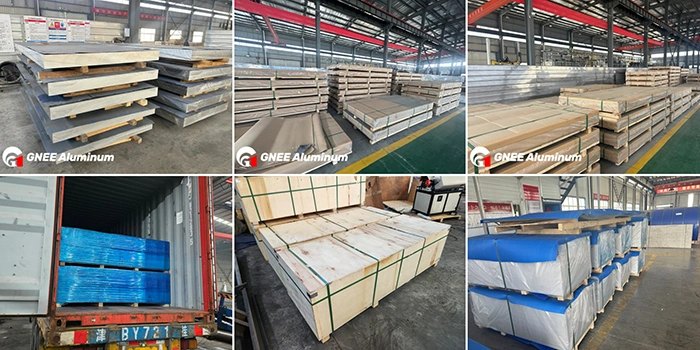
Sheets are stacked, separated and strapped on wooden pallets or packed in wooden cases suitable for sea freight, with edge and corner protection.
Export Packaging Requirements for Perforated Aluminum Sheet
Export packing uses PE or VCI wrap and clear shipping marks. Lead time is 15–30 days from order confirmation for standard specs; the exact time is confirmed after drawing review.
About GNEE
Supplying aluminum since 2008. GNEE exports wrought aluminum products to more than 100 countries and regions.
3003 H24 perforated aluminum sheet supplier and manufacturer. GNEE holds and processes 3003 H24 base sheet to standard and performs perforation and follow-up processing (cutting, deburring, leveling, finishing) to your drawing.
Small and large orders both accepted. MOQ is flexible - trial quantities and full containers are quoted on the same terms.
Lead time 15–30 days from order confirmation for standard specifications.
Documentation with every shipment. EN 10204 3.1 MTC standard; ISO 9001 certified; 3.2 and third-party inspection arranged on request.
Drawings reviewed before quoting. Sales engineers read the drawing and confirm alloy, temper, hole layout and finish before returning a written quote.

Request a Quote for Custom 3003 H24 Perforated Aluminum Sheet
Send your requirement - alloy and temper (3003 H24), sheet thickness, panel width × length, hole shape, hole diameter, hole pitch, arrangement, open area or target, edge margin, surface finish, quantity and application, or simply a CAD / PDF / DXF drawing. GNEE returns a written quote covering exact dimensions and tolerances, finish, packaging, MOQ, unit price and the 15–30 day lead time. Terms are FOB or CIF with payment by T/T or L/C; EN 10204 3.1 MTC ships with the order and 3.2 / third-party inspection is available on request.


FAQ
What is 3003 H24 perforated aluminum sheet?
It is 3003 aluminum-manganese alloy sheet in the H24 temper with controlled openings formed by perforating. 3003 is a 3xxx-series, non-heat-treatable alloy; H24 means strain-hardened to 1/2 hard and then partially annealed (stabilized). Hole shape, diameter, pitch, arrangement, open area and panel dimensions are specified per drawing or standard pattern.
What does H24 mean in 3003 aluminum?
In the Aluminum Association temper system, H24 means the sheet is strain-hardened to roughly the 1/2-hard condition and then partially annealed (stabilized). The practical result is a temper with more stable dimensions and residual stress than H14 (strain-hardened only) at a similar strength level. Exact mechanical values depend on thickness and the specified material standard, and are confirmed on the MTC.
What is the difference between 3003 H14 and 3003 H24 aluminum sheet?
Both reach about the 1/2-hard strength level, but their processing history differs. H14 is strain-hardened only; H24 is strain-hardened and then partially annealed. The H24 route generally gives better dimensional stability and lower residual stress, which can matter for flatness after perforation and for subsequent forming. Neither designation alone decides whether a given hole pattern is manufacturable - that depends on material condition, thickness, hole geometry and the process, confirmed by the drawing review.
What thickness is available for 3003 H24 perforated aluminum sheet?
3003 H24 base sheet is commonly supplied from about 0.5 mm to 6.0 mm for panel work; thicker plate sizes are fixed from the drawing. The workable thickness for a given hole size and open area is confirmed during the manufacturing review, because perforation removes material and affects stiffness.
Can 3003 H24 aluminum sheet be custom perforated?
Yes. GNEE reviews customer drawings and confirms round, square, slotted, hexagonal and custom hole patterns against available tooling and production capability. Submit the drawing or describe the application, and the technical team confirms hole diameter, pitch, arrangement, edge margin and finish.
Does open area affect the strength of perforated aluminum sheet?
Open area is the percentage of surface occupied by holes. A higher open area leaves less solid metal and a narrower ligament width between holes, which reduces remaining stiffness. The suitable sheet thickness must be evaluated together with hole diameter, pitch, panel dimensions and support conditions, not read from a fixed table.
Can you supply perforated sheets in stainless steel, carbon steel and copper?
Yes. In addition to aluminum perforated sheets, GNEE can supply perforated metal in stainless steel, carbon steel and copper, subject to grade, thickness, pattern and processing requirements. Share your drawing or specification to discuss the suitable material and configuration.
What information is needed for a 3003 H24 perforated aluminum sheet quotation?
Provide alloy and temper (3003 H24), sheet thickness, panel width × length, hole shape, hole diameter, hole pitch, arrangement, open area or target, edge margin, surface finish, quantity and application. A CAD, PDF or DXF drawing can replace most fields.
Request a quote for 3003 H24 perforated aluminum sheet - send alloy, thickness, size, hole layout, finish, quantity and standard, and GNEE returns a quote with MTC and lead time.
Hot Tags: 3003 H24 Perforated Aluminum Sheet, China 3003 H24 Perforated Aluminum Sheet manufacturers, suppliers, factory, Aluminum Sheet | Cut To Size, corrosion resistant aluminum sheet, curved aluminum sheet, soffit aluminum sheet, large quantity aluminum sheet, Aluminum Sheet Cut To Size