

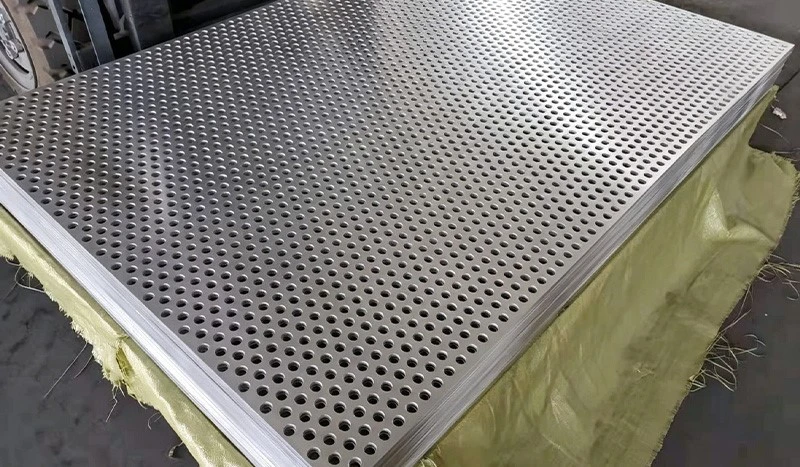
A railing is built from posts, a top rail and an infill that closes the opening between the rails. In a perforated metal railing, that infill is a sheet of metal with a regular hole pattern, cut and fixed into an aluminum or steel frame. GNEE supplies the perforated aluminum sheet - the infill material - to the railing manufacturer, fabricator or contractor, who builds and installs the full railing.
Aluminum fits this role because it is light, resists atmospheric corrosion, and lets the designer tune privacy, daylight and airflow through the hole pattern and open area. If you build or specify railings, GNEE discusses the aluminum sheet specification against your drawing and supplies the panels to your schedule.
Send us your required alloy, thickness, hole pattern and panel dimensions.
Applications of Perforated Aluminum Panels in Railing Systems
Perforated infill replaces bars or glass wherever a railing needs a continuous, ventilated screen. The same aluminum sheet serves several positions.
Perforated Aluminum Balcony Railing Panels
Balcony balustrades are the most common use: the panel gives privacy while letting light and breeze through, and its low weight keeps the balcony structure light. Pattern choice shifts the look from a fine mesh to a bold graphic screen, and an outdoor finish plus the local guardrail opening rule set the open area.
Perforated Aluminum Stair Railing Panels
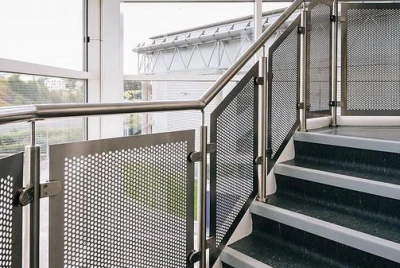
Indoor and outdoor stair guards use the same infill, including on angled runs where the panel is cut to the slope. Hole pattern, edge treatment and fixing points must align with the stair frame, and fall-protection rules set the maximum allowable opening. Aluminum keeps the stair assembly light and easy to handle.
Perforated Aluminum Deck and Terrace Railing Panels
Roof terraces, pool decks and outdoor leisure areas use perforated infill for visual screening and ventilation without blocking the view. These sites are exposed, so coating choice and drainage matter - standing water against a coated edge shortens finish life regardless of the base metal.
Perforated Aluminum Panels for Commercial and Public Building Railings
Offices, retail and public buildings need long runs of consistent panels with custom patterns, colors and tight batch matching. Supplying the sheet to a controlled specification keeps the visual continuity architects ask for, and aluminum keeps the long runs manageable in weight.


Materials for Perforated Aluminum Railing Panels: Aluminum, Stainless and Carbon Steel
Aluminum Perforated Sheets
Aluminum is light and resists atmospheric corrosion, which suits architectural infill and balcony panels. Common alloys differ in strength and formability:
| Alloy & temper | Tensile (MPa, indicative) | Use in railings |
|---|---|---|
| 3003-H14 | ~145 | general-purpose infill |
| 5052-H32 | ~215 | balconies, coastal, outdoor |
| 6061-T6 | ~310 | higher-strength infill |
Values are indicative, from typical ASTM B209 ranges; confirm against the ordered temper and mill test certificate.
Stainless Steel Perforated Sheets Versus Aluminum Panels
Stainless 304 and 316 give strong corrosion resistance, especially 316 in chloride-rich coastal or pool sites, with a polished or brushed look. The trade-off is weight and cost - roughly three times the weight of aluminum per square meter and a higher price - so it suits aggressive environments or specifications that require it.
Carbon Steel and Galvanized Steel Perforated Sheets Versus Aluminum
Carbon steel is the lowest-cost option and easy to fabricate; galvanizing or painting protects it. It is the heaviest of the three and needs maintenance once the coating is damaged, which fits commercial and industrial railings where budget and strength dominate.
Aluminum vs. Stainless Steel vs. Carbon Steel
| Property | Aluminum | Stainless steel (304/316) | Carbon steel |
|---|---|---|---|
| Density (g/cm³) | 2.70 | 7.9 – 8.0 | 7.85 |
| Relative panel weight | lightest (~1.0) | ~2.9× aluminum | ~2.9× aluminum |
| Tensile (MPa, indicative) | 145 – 310 by alloy | ~515 (304 annealed) | ~400 (structural) |
| Atmospheric corrosion | good; better with coating | very good | needs coating/galvanizing |
| Coastal / salt spray | good with proper finish | excellent (316 harshest sites) | poor unless well coated |
| Typical finish | anodized / powder / PVDF | polished / brushed | galvanized / powder |
Perforation Patterns and Open Area for Aluminum Railing Panels
The hole pattern drives both the look and the performance of the infill, so it is usually specified with the open area.
Common Perforation Patterns for Aluminum Panels
- Round hole - the default for railing infill; clean and even, usually 60-degree staggered.
- Square hole - a more architectural, gridded appearance.
- Slotted (long) hole - directional screening, common on louvred screens.
- Hexagonal hole - a honeycomb look with good open area.
- Custom decorative patterns - logo, motif or irregular layouts cut to the architect's drawing.

How Open Area Affects Privacy, Visibility and Ventilation of Aluminum Panels
Open area is the share of the panel that is hole. More open area means more airflow and visibility and less privacy; less open area screens more but cuts airflow, and it also removes load-bearing section, so it is balanced against panel strength and span. For 60-degree staggered round holes:
OA = 90.69 × (d / p)² (× 100 to express as a percentage)
where d is the hole diameter and p is the center-to-center pitch. This formula applies only to that arrangement, not to square, slotted or other layouts. For the full method and worked examples, see the Perforated Aluminum Open Area Calculation guide.
Choosing Hole Size and Spacing for Aluminum Railing Infill
Hole diameter and pitch set the open area and the remaining web, which changes stiffness. Hole size also interacts with guardrail opening rules that limit the maximum opening. Those rules vary by location and by stair versus balcony, so no single "safe" hole size or open-area limit is stated here; the applicable code is confirmed by the project engineer.
Perforated Aluminum Panel Specifications
The sheet specification is what a supplier quotes once the design is set.
| Size | 1) Thickness: 0.1mm~12mm
2) Mesh Length: ~1.8 m to ~2.44 m 3) Mesh Width: 0.8 m/1.22 m 4) Perforated area percent: from 7% to 83% |
| Hole forms | Diamond, round-hole perforated aluminum sheet, Square, Rectangular, Triangle, Hexagon, Hexagonal, Slotted, Oval, Club, Cross, Louver, Etc. |
| Surface Treatment | Paint spraying/coated/industrial mill finish/not polished, etc. |
| Color | Golden, silver, red, black, white, etc. |
| Hole diameter (pitch mm) | Customize, such as 2.0*5.0, 3.0*6.0 |
| Dimensions (mm)
(length*width*thickness |
Customize, such as 1000*2000*1.0,1250*2500*2.0 |
| Perforated pattern | Staggered: 45 degrees, 60 degrees, 120 degrees; Customize |
| Fabrication | Bend, coil, sheet, etc. |
| Material |
1050, 1060 perforated aluminum sheet, 1100, 3003 perforated aluminum sheet, 5052 perforated aluminum sheet, 5754, 6061-T6 Perforated Aluminum Sheet |
| Sample time | About 7 days |
| Delivery time | 10-25 days after payment |
| Payment terms | T/T (30% deposit after confirm the order, 70% balance paid before shipment) |
| Packing | 1. Pallets 2. Other special packages according to customers' requirements. |
Panel Edges, Framing and Mounting Compatibility for Aluminum Infill
Infill panels ship as flat sheets, folded edges, or sheets prepared to drop into a frame, with U-channel or J-channel edges and fixing holes matched to the downstream frame. GNEE supplies and discusses the sheet - thickness, hole pattern, edges and finish - to the drawing; the frame, connectors and final assembly are completed by the railing manufacturer.
Surface Finishes for Outdoor Perforated Aluminum Railing Panels
Powder Coating for Perforated Aluminum Panels
Powder coating gives a durable, uniform color from a wide RAL range and covers both faces and hole edges. It can be applied before or after perforation; after perforation gives better edge coverage but needs clean, deburred holes first. A double-side coat, as on the Oslo balcony panels, protects both visible faces.
Anodizing for Aluminum Railing Infill Panels
Anodizing builds a hard, integral oxide layer in natural, champagne or bronze tones. It is durable and low-maintenance, though the color range is narrower than paint, and edge consistency through the holes depends on the anodizing line and rack points, which are part of the specification.
PVDF Coating and Weather Resistance of Aluminum Panels
PVDF (fluoropolymer) coating is used on building exteriors where long-term color stability and weather resistance matter most. It costs more than standard powder but holds color and gloss far longer in sun and pollution, which suits large public-facing facades and railings.


Price and Lead Time for Perforated Aluminum Railing Panels
For buyers comparing materials and suppliers, these commercial terms apply to GNEE's perforated aluminum sheet supply:
- MOQ flexible - small trial orders and large-volume or container orders both accepted; larger runs welcome.
- Lead time - typically 15–30 days after order confirmation.
- Mill certificate - EN 10204 3.1 MTC with every shipment; 3.2 and third-party inspection (SGS / BV / TÜV) on request.
- Pricing - quoted per order, benchmarked to SMM (Shanghai Metals Market) with alloy premium and processing added.
- Response - technical and quotation reply within 24 hours of a complete inquiry.
Request a quote for perforated aluminum sheets
Engineering and Safety Considerations for Perforated Aluminum Railing Panels
A perforated panel is part of a safety barrier, so the engineering context belongs in the spec, not just the appearance.
Load Requirements and Panel Strength of Aluminum Infill
The infill must carry the design load set by the code for its position. Perforation removes section, so the remaining web, panel span, support points and fixing method all set the load the panel takes. Alloy, temper and base thickness are chosen with the span - a thin, highly perforated panel over a wide gap will not meet a load case that a thicker, lower-open-area panel would.
Building Codes and Guardrail Safety for Aluminum Panels
Guardrails are governed by the building code at the project location, which sets height, maximum allowable opening, load resistance and connections. A perforated infill meets those rules only with the frame. A plain decorative perforated sheet is not, by itself, a compliant guardrail; the structural verification is completed by the project engineer or railing system manufacturer.
Corrosion and Dissimilar Metal Contact with Aluminum Panels
In humid or coastal settings, aluminum depends on the finish and on avoiding galvanic corrosion where it touches stainless or carbon steel. Direct, wet contact with a more noble metal accelerates corrosion of the aluminum; isolation, correct fasteners and good drainage prevent it. Design the connection and drainage with the fabricator rather than assuming the panel alone is enough.
About GNEE
GNEE Aluminum has supplied aluminum products to international buyers since 2008, shipping to 100+ countries and regions from China. For railing infill, the team discusses the aluminum sheet specification against the customer's drawing and supports alloy selection, hole-pattern definition and finish choice per project.
Multiple aluminum alloys and tempers for infill panels, with custom thickness and hole patterns to drawing.
Typical lead time 15–30 days; MOQ flexible, with both small and large orders accepted.
EN 10204 3.1 mill test certificate with every shipment; 3.2 and third-party inspection on request.
Pricing benchmarked to SMM, quoted per order; technical and quotation reply within 24 hours.
Works with compliant destinations and eligible end-users only; supplies sheet material, not complete railing systems.

FAQ
What is a perforated metal railing infill panel?
A railing has posts, a top rail and an infill that closes the opening between them. A perforated metal railing infill panel is a metal sheet - usually aluminum - punched with a regular hole pattern and fitted into the frame. GNEE supplies that perforated aluminum sheet; the full railing system is built and installed by the railing manufacturer.
Can aluminum perforated sheets be used for balcony railings?
Yes. They are widely used as balcony balustrade infill because they are light, resist atmospheric corrosion and balance privacy, light and airflow. A 2026 Oslo apartment project used 170 double-side powder-coated 2 mm aluminum perforated panels across 22 balconies, supplied loose and fitted by the customer onto aluminum railing structures. Thickness and open area follow the project drawing and local code.
Is aluminum or stainless steel better for perforated railing panels?
Neither is universally right. Aluminum is about one-third the weight of stainless per panel and easier to coat, suiting most balconies and stairs. Stainless 304 or 316 resists corrosion in aggressive coastal or chemical sites but costs more and is much heavier. Carbon steel is lowest-cost but needs coating and maintenance. Choose by weight budget, corrosion exposure and cost.
What thickness is suitable for perforated metal railing panels?
Balcony, stair and terrace infill commonly uses about 1.5–3.0 mm base thickness, with 2.0 mm a frequent choice for stiffness without excess weight. Thickness is a structural decision set by span, support spacing and design load - not a fixed industry standard. GNEE supplies a range of thicknesses to your drawing; the final check is done by the project engineer.
What perforation pattern works for balcony railing panels?
Round holes in a 60-degree staggered layout are most common for even open area and a clean look. Square, slotted and hex patterns serve different visual or directional effects. The choice follows the target open area, the architectural style and the local guardrail opening rules - there is no single pattern that fits every project.
How does open area affect privacy and ventilation?
Open area is the percentage of the panel that is hole. More open area gives more airflow and visibility and less privacy; less open area screens more but reduces airflow. It also removes load-bearing section, so it is balanced against panel strength and span. For 60-degree staggered round holes, open area is 90.69 × (hole diameter ÷ pitch)².
Can perforated aluminum panels be powder coated?
Yes. Powder coating gives a durable, uniform color from a wide RAL range and covers both faces and hole edges. It can be applied before or after perforation; after perforation gives better edge coverage but needs clean, deburred holes. Confirm the coating system, film thickness and color with the supplier per the project specification.
Can perforated metal panels be customized according to drawings?
Yes. Infill panels are made to the customer's drawing: alloy, temper, thickness, dimensions, hole pattern, hole size, pitch, open area, edge treatment, finish and quantity. Send a CAD or PDF with the perforation layout and the supplier can quote the sheet and processing. GNEE discusses the aluminum sheet spec against your drawing, not a finished railing.
Are perforated aluminum panels suitable for outdoor railings?
Yes, for most outdoor settings. Aluminum resists atmospheric corrosion well, and a powder-coated or anodized finish extends life and color stability. In coastal or high-salt sites, specify a suitable coating and avoid dissimilar-metal contact. Perforated aluminum is not a certified guardrail by itself - structure, height, load and fixings come from the railing system and local code.
Do perforated railing panels need to meet building codes?
Yes. Guardrails are regulated by the building code at the project location, which sets height, maximum allowable opening, load resistance and connections. A perforated infill meets those rules only together with the frame. GNEE supplies the panel to the specified drawing; structural verification and code compliance are confirmed by the project engineer or railing system manufacturer.