

The main differences between 5052 and 5083 aluminum alloys lie in their strength, corrosion resistance, and formability. 5083 is a stronger and more corrosion-resistant alloy with a higher magnesium content, making it suitable for heavy-duty applications like ship hulls and bulkheads. On the other hand, 5052 is more formable and easier to work with, making it ideal for applications like decks, hatches, and general sheet metal work.
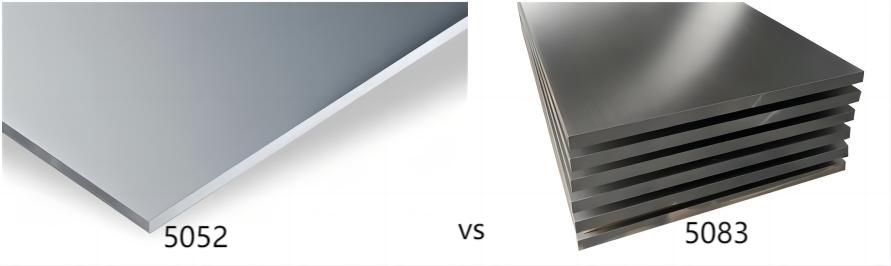
| Feature | 5052 | 5083 |
|---|---|---|
| Strength | Good strength, but lower than 5083 | Higher strength, approximately 1.5 times the tensile and yield strength of 5052 |
| Corrosion Resistance | Good, but not as good as 5083, especially in saltwater | Excellent, particularly resistant to seawater and industrial chemicals |
| Formability | More formable and easier to bend and shape | Less formable, more difficult to bend due to higher strength |
| Magnesium Content | Approximately 2.8% | Approximately 4.0-4.9% |
| Typical Applications | Decks, hatches, doors, general sheet metal work, appliances | Ship hulls, bulkheads, stringers, structural components, transport, and industrial applications |
| Weldability | Good | Retains exceptional strength after welding |
GNEE, a trusted Chinese supplier, offers high-quality 5052 and 5083 aluminum alloys, providing tailored solutions for a wide range of marine and industrial applications.
Alloy 5083 aluminum plates offer higher strength compared to 5052 aluminum plates and provide exceptional thermal conductivity.
5083 aluminum alloy is a magnesium-based alloy with traces of manganese and chromium. It is highly resistant to corrosion from seawater and industrial chemicals.
One of the key advantages of 5083 alloy is its ability to retain exceptional strength after welding. It is the highest strength non-heat treatable alloy, with an Ultimate Tensile Strength of 317 MPa (46,000 psi) and a Tensile Yield Strength of 228 MPa (33,000 psi). However, it is not recommended for use in temperatures exceeding 65 °C.
Chemical Composition of 5083 Aluminum:
Aluminum: balance
Chromium: 0.05-0.25% max
Copper: 0.1% max
Iron: 0.4% max
Magnesium: 4.0 to 4.9%
Manganese: 0.4 to 1.0%
Silicon: 0.4% max
Titanium: 0.15% max
Zinc: 0.25% max
The alloy maintains good formability due to its excellent ductility, even in tempered conditions. It is highly suitable for welding and can be hardened through cold working.
Thanks to its outstanding resistance to general corrosion, 5083 aluminum is widely used in marine applications. Furthermore, this alloy can withstand extremely low temperatures without becoming brittle or losing its properties, making it ideal for cryogenic applications.

Typical Industrial Sectors for 5083 Aluminum:
LNG ship construction
Pressure vessels
Storage tanks
Welded structures (high strength)
Armor plate
Drilling rigs
On the other hand, 5052 aluminum alloy offers excellent forming and processing capabilities, good corrosion resistance, and medium strength. It is commonly used in the manufacture of aircraft fuel tanks, oil pipes, sheet metal parts for transportation vehicles, ships, meters, street light brackets, rivets, and hardware products. Additionally, it is used in the production of beverage can lids (in H19 temper), with improved adhesion and corrosion resistance achieved through anodization. GNEE provides high-quality 5052 aluminum, particularly for alloy tank covers and other materials with stable performance.
The 5000 series aluminum alloys primarily consist of aluminum and magnesium. These alloys are known for their medium to high strength, excellent resistance to seawater corrosion, and exceptional weldability. Some of the most common grades in this series include 5005, 5049, 5050, 5052, 5083, 5086, 5059, and 5182.
In terms of strength and hardness, the 5000 series alloys generally have higher strength compared to the 3000 and 1000 series alloys (5xxx > 3xxx > 1xxx), with a typical strength level around 300 MPa. These alloys are widely used in marine environments, coastal construction, optical supplies, structural materials, and cryogenic containers.
5052 aluminum, in particular, is known for its excellent corrosion resistance, particularly against seawater. This makes it a popular choice for marine applications, such as shipping containers for gas and oil tankers, and other marine-grade components. Additionally, 5052 aluminum is durable and outperforms many other alloys when exposed to harsh marine environments.
Welding 5052 aluminum is straightforward, as it can be easily soldered without the need for special procedures. Common welding methods include metal inert gas (MIG) welding and tungsten inert gas (TIG) welding.
While there are other alloys with greater strength and toughness, 5052 remains a solid choice in many applications, offering a good balance of strength, durability, and corrosion resistance.
5083 aluminum, often used in shipbuilding, is another prominent alloy in the marine industry. Common tempers for 5083 include H111, H112, H116, and H321. This alloy is widely used for ship hulls and yachts, with medium to thick aluminum plates being typical.
5083-H111: This temper is suitable for products that have undergone moderate work hardening after final annealing, but with a lower degree of hardening than the H11 state.
5083-H112: This temper is ideal for hot-rolled plates and hot-processed products, with good performance stability.
5083-H116/H321: These tempers are ideal for marine applications, as they offer stability and resistance to seawater corrosion.
While 5052 aluminum is easier to process and form, 5083 aluminum offers approximately 1.5 times the tensile and yield strength of 5052. This means that for the same thickness, a boat made from 5083 aluminum can withstand much higher pressure without breaking or deforming compared to one made from 5052 aluminum.
At GNEE, we offer a wide range of high-quality 5083 and 5052 aluminum alloys, ensuring strong, durable, and corrosion-resistant solutions for marine and other industrial applications.