

6061-T6 is the default structural aluminum for unmanned aerial vehicle (UAV) airframes. Its combination of medium-high strength, good weldability, clean machinability, and a density roughly one-third that of steel lets drone builders trade carbon-fiber cost and repair complexity for a material that is easy to prototype, weld, and rework. This overview covers what the alloy is, where it sits in a drone structure, why it beats the alternatives on most airframes, and the fabrication and design rules that keep rejection rates low.
1. Which standards apply to 6061 aluminum alloy?
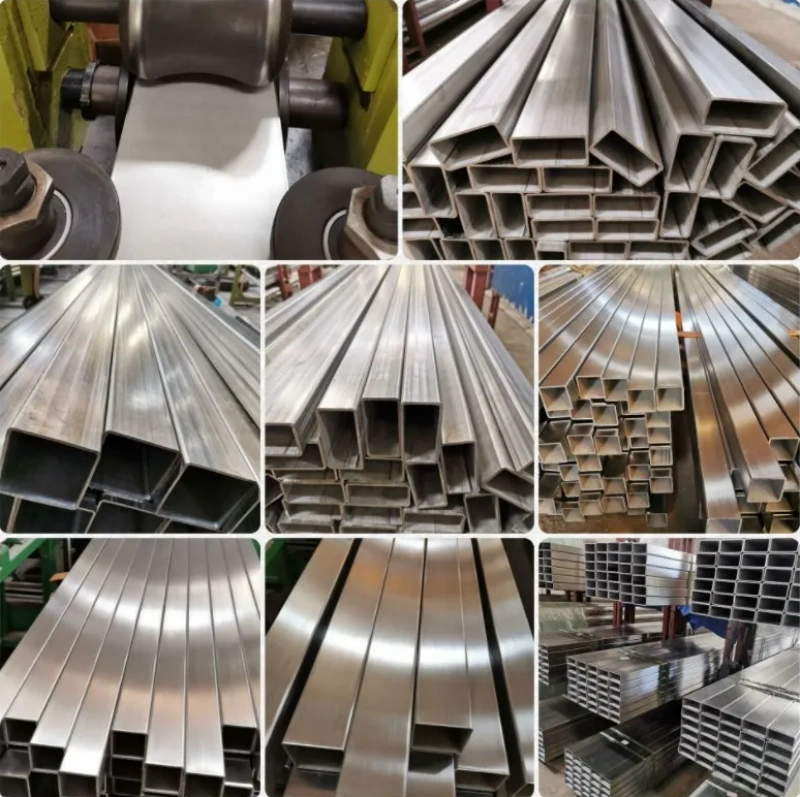
6061 is a heat-treatable 6xxx-series wrought aluminum alloy strengthened by magnesium-silicide (Mg₂Si) precipitates. It is the general-purpose structural grade of the aluminum family: when a part has no specific reason to be anything else, it is usually 6061. In the forms used for drone structures - extruded profiles, drawn tubes, and plate - the relevant purchase and verification standards are:
ASTM B221 - extruded aluminum alloy bars, rods, wire, profiles, and tubes (the primary form for UAV frames and arms).
ASTM B210 - drawn seamless aluminum alloy tube (tight-tolerance drone booms and mast sections).
ASTM B209 - aluminum alloy sheet and plate (motor-mount plates, battery trays, enclosure panels).
EN 573-3 / EN 755 / EN 485 - European composition and extruded/plate product standards.
GB/T 3190 / GB/T 6892 / GB/T 3880 - Chinese composition, extrusion, and plate standards.
ISO 209-1 - international alloy designation and composition limits.
Designers specify it because it carries real load, welds and machines without special setups, and anodizes for both protection and appearance.
2. 6061 Equivalent Designations
| Standard System | Designation | Notes |
|---|---|---|
| AA (Aluminum Association) | 6061 | Base alloy; T6 is the aged structural temper |
| UNS | A96061 | Unified Numbering System |
| EN / EN AW | EN AW-6061 | European wrought designation |
| GB (China) | 6061 | Same numeric grade under GB/T 3190 |
| JIS (Japan) | A6061 | JIS H4000 / H4040 |
| ISO | AlMg1SiCu | ISO 209-1 chemical formula name |
3. Chemical Composition of 6061-T6 Aluminum (wt %) - per EN 573-3 / GB/T 3190 / AA
| Element | Symbol | Min | Max | Role |
|---|---|---|---|---|
| Magnesium | Mg | 0.80 | 1.20 | Forms Mg₂Si precipitates; primary strength source |
| Silicon | Si | 0.40 | 0.80 | Forms Mg₂Si with Mg; improves fluidity and weldability |
| Copper | Cu | 0.15 | 0.40 | Raises strength and hardness |
| Chromium | Cr | 0.04 | 0.35 | Controls grain structure and corrosion behavior |
| Iron | Fe | - | 0.70 | Impurity; kept low for surface finish |
| Manganese | Mn | - | 0.15 | Minor dispersoid former |
| Zinc | Zn | - | 0.25 | Impurity limit |
| Titanium | Ti | - | 0.15 | Grain refiner |
| Aluminum | Al | Remainder | Remainder | Base metal |
Values are composition limits per the listed standards; actual mill-certificate values vary within range.
4. Mechanical Properties of 6061-T6 Aluminum by Temper
| Temper | UTS (MPa) | Yield 0.2% (MPa) | Elongation (%) | Hardness (HB) | Shear (MPa) |
|---|---|---|---|---|---|
| O (annealed) | 124 | 55 | 25 | 30 | - |
| T4 | 241 | 145 | 22 | 65 | - |
| T6 (anchor) | 310 | 276 | 12 | 95 | 207 |
| T651 (stress-relieved) | 310 | 276 | 12 | 95 | 207 |
Why T6 is the airframe default. T6 (solution heat-treated then artificially aged) gives 6061 its full structural strength - about 310 MPa ultimate and 276 MPa yield - while staying machinable and weldable. T651 is the same temper with stretch stress-relief, preferred for thick plate where flatness during CNC matters. T4 and O are softer and used only where forming comes before aging.
5. Physical Properties of 6061-T6 Aluminum (Typical)
| Property | Value | Unit |
|---|---|---|
| Density | 2.70 | g/cm³ |
| Melting range | 582 – 652 | °C |
| Elastic modulus | 68.9 | GPa |
| Shear modulus | 26 | GPa |
| Poisson's ratio | 0.33 | - |
| Thermal conductivity | 167 | W/m·K |
| Coefficient of thermal expansion | 23.6 | µm/m·°C |
| Electrical conductivity | 40 – 43 | % IACS |
Sources: ASM Handbook and Aluminum Association typical values. Density at one-third of steel is the basis of the weight-saving case for UAV structures.
6. Heat Treatment and Temper Guide for 6061 Aluminum
| Temper | Process | Characteristics | Typical Use |
|---|---|---|---|
| T4 | Solution ~530 °C, quench, natural age | Softer, more formable than T6 | Form-then-age parts, complex bends |
| T6 | Solution ~530 °C, quench, age 175 °C × 8 h | Peak strength, good machining | Structural frames, mounts, arms |
| T651 | T6 + stretch stress-relief (1–3%) | T6 strength, better dimensional stability | Thick plate, precision CNC |
| O | Fully annealed | Maximum ductility, lowest strength | Deep drawing, severe forming |
For extrusions the standard artificial-aging cycle is about 175 °C for 8 hours; for plate the equivalent is about 160 °C for 18 hours. The exact cycle is confirmed by the supplier's heat-treat certificate.
7. Specification of 6061-T6 Aluminum for Drone Structures
| Parameter | Details |
|---|---|
| Alloy / Temper | 6061-T6 (also T651 for plate) |
| Forms supplied | Extruded profiles, drawn tubes, sheet, plate |
| Tube outside diameter | 4 – 90 mm (common tooling to φ76) |
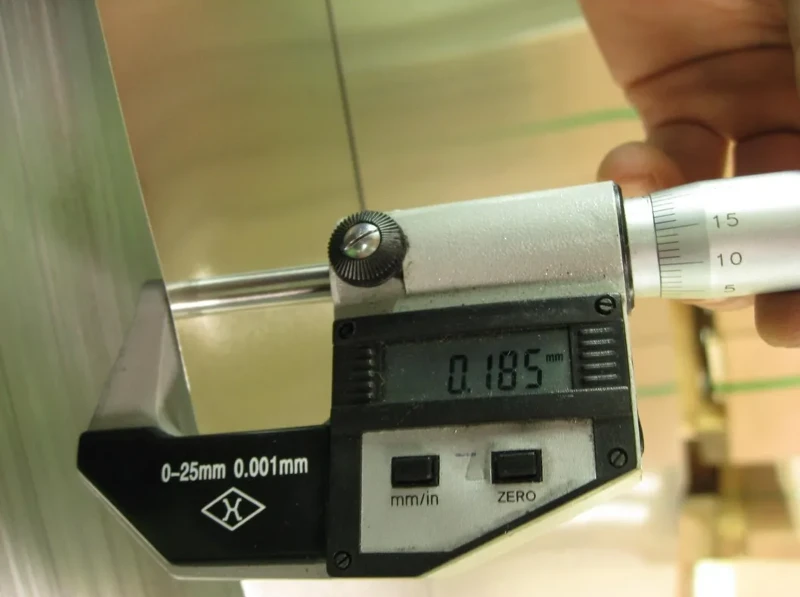
| Tube wall thickness | 1.0 – 2.0 mm for airframe booms |
| Sheet / plate thickness | 0.5 – 200 mm |
| Length | Cut-to-length per drawing; standard 3 – 6 m bars |
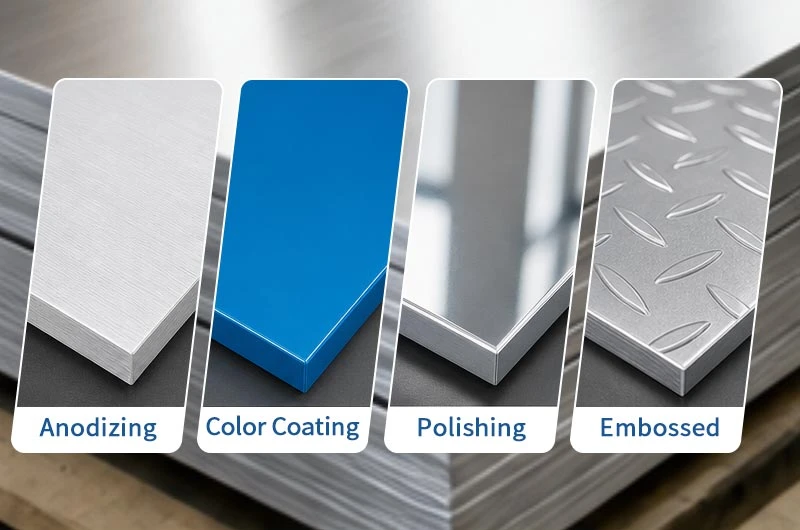
| Surface | Mill finish, anodized (Type II/III), powder coat |
| Packaging | Seaworthy export packing, PE-wrapped, palletized |
8. Corrosion Resistance of 6061-T6 Aluminum
Atmospheric: Forms a stable Al₂O₃ film; performs well in outdoor and industrial air without heavy coating.
Marine: Good with anodizing, but less resistant than 5xxx grades (e.g., 5052) in long-term seawater exposure - use coating or isolation for salt-spray environments.
Galvanic: Anodic against steel and stainless; isolate fasteners or use coatings to avoid preferential corrosion.
Stress-corrosion cracking: Low susceptibility in T6 for normal airframe sections; avoid severe crevice + sustained tensile stress combinations.
Recommended finishes: Anodizing (Type II/III) for protection plus appearance; powder coat for color and extra barrier.
9. Fabrication and Processing of 6061-T6 Aluminum
Welding 6061-T6 aluminum
6061-T6 welds well by TIG or MIG using ER4043 or ER5356 filler. ER4043 gives better crack resistance and a cleaner anodize tone; ER5356 yields higher joint strength but can darken under anodizing. Expect the heat-affected zone (HAZ) to drop to roughly T4 strength (about 210 MPa), so design welded joints with gussets or plan post-weld heat treatment where the load path is critical. Avoid pairing aluminum directly with steel fasteners in wet service.
Machining 6061-T6 aluminum
6061-T6 is one of the most machinable aluminum alloys in the structural range. Use sharp carbide tooling, high surface speed, and moderate feed; it cuts cleanly with minimal built-up edge. This makes it the natural choice for CNC motor mounts, fork arms, and payload brackets where tight tolerances matter.
Forming and bending 6061-T6 aluminum
T6 is the stiffest of the common tempers to bend - minimum bend radius is about 3.0 × thickness, versus 2.0 × t for T4 and 1.0 × t for O. For tight-radius or large-angle bends, the standard industry path is to form in T4 (or anneal to O) and then artificially age to T6, regaining strength after shape is set.
| Temper | Min bend radius (× thickness) | Forming note |
|---|---|---|
| O | 1.0 × t | Preferred for tight radii and deep shapes |
| T4 | 2.0 × t | Form first, then age to T6 |
| T6 | 3.0 × t | Hardest to bend; evaluate large angles early |
For tube bending, a practical wall-thickness rule links wall to outside diameter: up to 10 mm OD needs at least 1.0 mm wall, up to 15 mm OD uses 1.2–1.5 mm, and 20 mm OD and above use 1.5–2.0 mm. A simple difficulty check: if wall thickness is at or above twice the bend radius, the bend is straightforward; below 2R it needs a mandrel (core rod) to avoid collapse or wrinkling. Thin walls on large diameters are the hardest class to bend and should be evaluated before quoting.
Surface finishes for 6061-T6 aluminum
| Finish | Method | Use on drone parts |
|---|---|---|
| Mill finish | As-extruded / as-rolled | Internal structure, hidden brackets |
| Anodized Type II | Sulfuric anodize, clear/color | Appearance parts, mild corrosion barrier |
| Anodized Type III (hardcoat) | Thick anodize | Wear surfaces, hard points |
| Brushed | Mechanical grain | Cosmetic covers |
| Powder coat | Electrostatic + cure | Color coding, extra barrier |
Design considerations for 6061-T6 aluminum drone frames
Wall vs. diameter: Size tube walls from the OD rule above; under-walled large tubes wrinkle or collapse in bending.
HAZ in welded joints: Locate welds away from peak moment sections, or add gussets; remember the joint loses roughly a third of T6 strength locally.
Bend radius budget: Keep bends at or above 3 × t for T6, or spec T4-form-then-age where geometry demands tighter radii.
Stiffness over pure strength: 6061-T6 elastic modulus is fixed at ~69 GPa, so use I-beam or box extrusions rather than thicker walls to raise bending stiffness without adding weight.
Fastener isolation: Use steel inserts (e.g., Helicoil) for repeated threaded joints and isolate aluminum from stainless in wet areas to prevent galvanic corrosion.
Tolerance stack-up: Specify T651 plate where flatness after CNC matters; allow for springback on thin-wall formed parts.
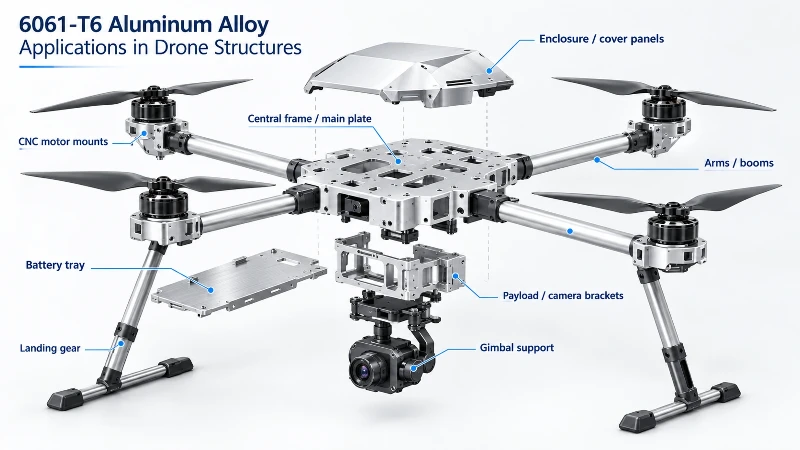
10. Applications of 6061-T6 Aluminum in Drone Structures
| Drone part | Form | Why 6061-T6 fits |
|---|---|---|
| Central frame / main plate | Sheet, plate | High stiffness-to-weight; easy CNC and anodize |
| Arms / booms | Extruded or drawn tube | 1.5–2.0 mm walls carry flight loads; bends cleanly in T4/O then aged |
| Motor mounts | CNC plate | Excellent machinability for tight bolt patterns |
| Landing gear | 6061-T6 Aluminum Tube, extrusion | Tough, repairable, lighter than steel |
| Battery tray | Sheet | Flat, light, electrically non-magnetic |
| Payload / camera brackets | Extrusion, machined plate | Rigid support; anodized for finish |
| Enclosure / cover panels | 6061-T6 Aluminum Sheet | Anodized appearance; EMI-transparent |
| Gimbal support | Machined plate | Dimensional stability, good fatigue resistance |
Send GNEE your drone drawing and alloy requirement for a stock-or-custom quote on 6061-T6 profiles, tubes, and plate.
11. 6061-T6 vs 6063-T6 vs 6082-T6 vs 7075-T6 Aluminum: Key Differences
| Alloy (T6) | Series | UTS (MPa) | Yield (MPa) | Elong (%) | Density (g/cm³) | Relative cost* | Primary use |
|---|---|---|---|---|---|---|---|
| 6061-T6 | 6xxx | 310 | 276 | 12 | 2.70 | 1.00 | General structural frames, mounts |
| 6063-T6 | 6xxx | 241 | 214 | 12 | 2.70 | 0.95 | Appearance extrusions, anodized parts |
| 6082-T6 | 6xxx | 310 | 255 | 10 | 2.70 | 1.05 | Structural (EU-preferred), bridges |
| 7075-T6 | 7xxx | 572 | 503 | 11 | 2.81 | 1.60 | High-strength aerospace, high-payload UAV |
*Relative cost is indicative and market-dependent, benchmarked to SMM (Shanghai Metals Market); actual indices vary by form and volume. 6061-T6 leads on the strength-to-cost balance for most airframes; 7075-T6 is reserved for high-payload or long-endurance designs where the weight saving justifies the premium and where bending is done after annealing.
12. FAQ
Q: Why is 6061-T6 used for drone frames instead of 6063?
A: 6061-T6 delivers about 310 MPa UTS and 276 MPa yield - roughly 30% above 6063-T6 - which matters for load-bearing arms and motor mounts. 6063 is chosen only when anodized appearance or thin-wall cosmetic parts dominate.
Q: Can 6061-T6 aluminum tube be bent for drone arms?
A: Yes, but T6 is the hardest temper to bend (minimum radius ~3.0 × thickness). For tight radii, form in T4 or O and age to T6, or keep wall at or above 2 × the bend radius to avoid a mandrel. Evaluate large-angle bends at the quoting stage.
Q: Is 6061-T6 aluminum weldable, and which filler is used?
A: It welds well by TIG/MIG with ER4043 or ER5356. Expect a strength drop to roughly T4 level in the HAZ, so design joints with gussets or post-weld heat treat where the load path is critical.
Q: What wall thickness should 6061-T6 drone tubes use?
A: Link wall to OD: up to 10 mm OD needs ≥1.0 mm, up to 15 mm OD uses 1.2–1.5 mm, and 20 mm OD and above use 1.5–2.0 mm. Thin walls on large diameters are the hardest to bend without wrinkling.
Q: How does 6061-T6 compare with 7075 for UAV structures?
A: 7075-T6 is far stronger (~572 MPa UTS) but costs more, machines and welds with more difficulty, and must be annealed before bending. 6061-T6 covers most airframes at lower cost and easier fabrication; reserve 7075 for high-payload or long-endurance airframes.
Q: What lead time and MOQ does GNEE offer for 6061-T6?
A: GNEE supplies 6061-T6 with a flexible MOQ (small trial orders and large-volume or container orders both accepted) and a lead time of 15–30 days, with EN 10204 3.1 mill certificates and pricing benchmarked to SMM. Inquiries are answered within 24 hours.
Price and lead time for 6061-T6 aluminum extrusions and tubes
GNEE's commercial terms for 6061-T6 drone material are built for small-batch, multi-variety, fast-turnaround programs:
MOQ flexible - small trial orders and large-volume, container, or long-term contract orders are both accepted; larger orders are especially welcome.
Lead time 15–30 days for standard and custom-cut profiles, tubes, and plate.
Mill certificate - EN 10204 3.1 MTC shipped with every batch (3.2 and third-party inspection available on request).
Pricing - quoted per order, benchmarked to SMM (Shanghai Metals Market) aluminum price with form and tolerance factored in.
Response - inquiries answered within 24 hours.
About GNEE
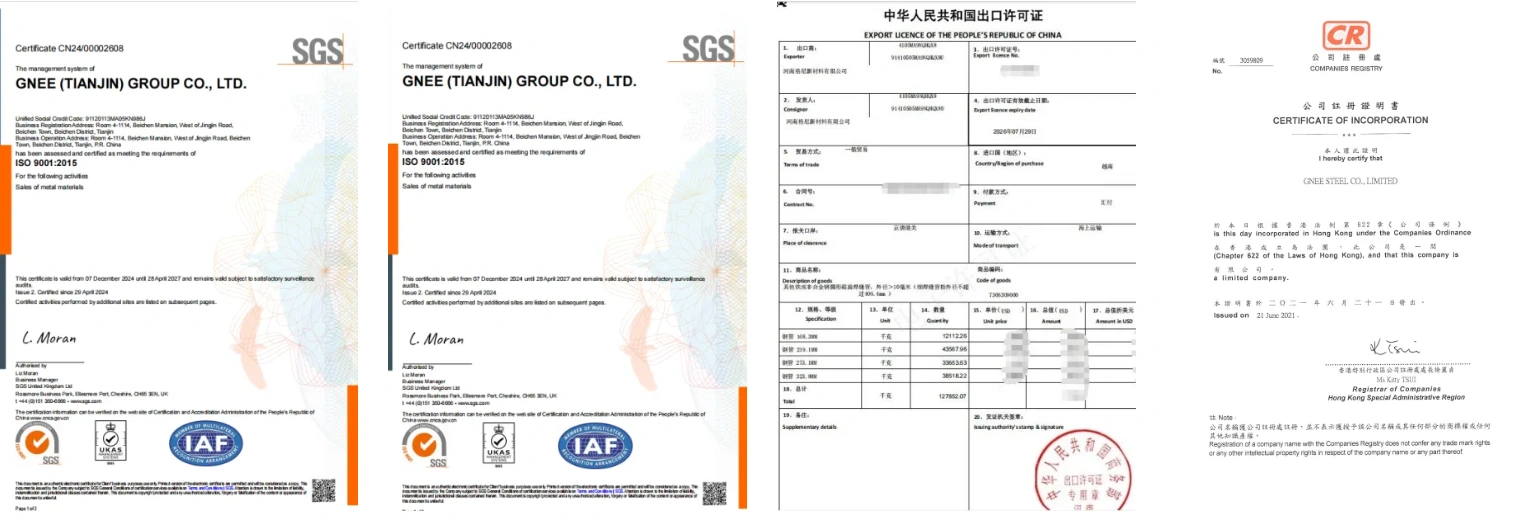
GNEE is an aluminum supplier established in 2008 and shipping to more than 100 countries and regions. For drone and robotics builders we stock and process 6061-T6 extrusions, drawn tubes, and plate, with cutting, bending, CNC, and anodizing support and full EN 10204 3.1 traceability. Our commercial model is built around flexible order sizes and a 15–30 day lead time, so prototype batches and production runs draw from the same supply chain. Send a drawing and we return a stock-or-custom proposal with mill certificates and SMM-benchmarked pricing inside 24 hours.
Talk to GNEE about 6061-T6 for your airframe.
Request a quote for 6061-T6 aluminum drone material
If you are specifying 6061-T6 for a UAV airframe, arms, mounts, or enclosures, GNEE can supply stock forms or cut-and-finish to drawing. Share alloy, temper, form, dimensions, and quantity, and we return a quote with lead time and mill certificate details.