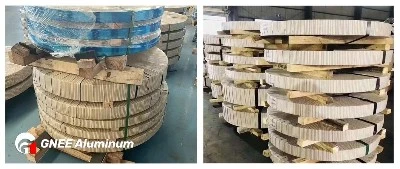
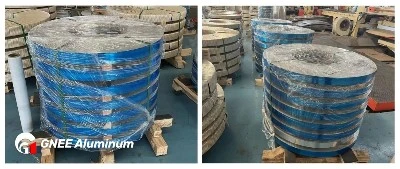
As an important raw material in industry, aluminum strip is an aluminum deep-processed product formed by aluminum coil slitting.
According to the different alloying elements contained in the aluminum strip, there are 8 series in aluminum strips and aluminum plates. The commonly used series are 1000, 3000, 5000 and 8000 series.
The aluminum strip has two state due to the different annealing state: soft (o state) semi-hard (H24) and fully hard (h18). The most commonly used one is the all-soft series because the O state is easier to stretch and bend.
Aluminum Strip Properties (Theoretical)
| Molecular Weight | 26.98 |
|---|---|
| Appearance | Silvery |
| Melting Point | 660.37 °C |
| Boiling Point | 2467 °C |
| Density | 2700 kg/m3 |
| Solubility in H2O | N/A |
| Electrical Resistivity | 2.6548 microhm-cm @ 0 °C |
| Electronegativity | 1.5 Paulings |
| Heat of Fusion | 2.55 Cal/gm mole |
| Heat of Vaporization | 67.9 K-Cal/gm at om at 765 °C |
| Poisson's Ratio | 0.35 |
| Specific Heat | 0.215 Cal/g/ K @ 25 °C |
| Tensile Strength | 6800 psi Coldroled 16,000 psi. |
| Thermal Conductivity | 2.37 W/cm/ K @ 298.2 K |
| Thermal Expansion | (25 °C) 23.1 µm·m-1·K-1 |
| Vickers Hardness | 167 MPa |
| Young's Modulus | 70 GPa |
The main processing equipment of the aluminium strip is the slitting unit, which can be divided into different lengths and widths according to the requirements. Of course, the equipment for slitting processing is universal, and copper coils can also be processed, and the finished products are called copper strips.
Internationally, the raw materials of electronic products no longer rely solely on copper strips. Since the electrical conductivity of aluminium is only lower than that of copper, the replacement of copper strips with aluminum strips is becoming an international trend.