

EN 485-2 and EN 485-4 are European standards that define the requirements for aluminum sheet, plate, and strip. EN 485-2 specifies the mechanical properties of aluminum alloys, while EN 485-4 covers tolerances on dimensions and shape. Together, they ensure consistent quality, mechanical performance, and strict dimensional accuracy for aluminum products widely used in aerospace, marine, automotive, and general engineering applications.
Sourcing EN 485 Compliant Aluminum for Your Project?
We are a direct EN 485-2 aluminum sheet supplier providing standard and custom dimensions with complete EN 10204 3.1 Mill Test Certificates.
Contact Our Engineering Team for Current Pricing & Stock Availability
What is EN 485-2 for 5083 Aluminum Plate?
In industrial manufacturing, knowing exactly how a material will behave under stress is critical. EN 485-2 is a European standard that specifies the mechanical properties of aluminum and aluminum alloys in sheet, strip, and plate form.
When you purchase a heavy-duty material like a marine-grade 5083 aluminum plate, EN 485-2 dictates the exact mechanical limits the metal must pass before it leaves the mill.
It includes rigorous testing parameters for:
- Tensile Strength (Rm): The maximum stress the aluminum can withstand while being stretched or pulled before breaking.
- Yield Strength (Rp0.2): The point at which the aluminum begins to deform plastically and will not return to its original shape.
- Elongation (A50mm): A measure of the material's ductility, showing how much it can stretch before fracturing.
EN 485-2 defines how strong and ductile an aluminum product must be.
For example, if an automotive manufacturer is stamping panels, they rely on the elongation and yield strength values defined in EN 485-2. If the material does not meet these minimum requirements, it will crack during the press-brake operation, leading to high scrap rates. By enforcing this standard, manufacturers guarantee that structural integrity is never compromised.
What is EN 485-4 for 6061 Aluminum Panel?
While EN 485-2 handles the internal strength of the metal, physical exactness is equally important. EN 485-4 is a European standard that defines tolerances on dimensions and shape for aluminum sheet, strip, and plate.
For precision-machined parts, such as those made from a 6061 aluminum panel, dimensional deviation can cause major manufacturing bottlenecks. EN 485-4 provides the acceptable plus/minus limits for the physical size of the product.
It covers:
- Thickness Tolerance: Ensuring the sheet is not too thick (which adds unnecessary weight and cost) or too thin (which weakens structural safety).
- Width and Length Tolerance: Critical for automated laser cutting and CNC feeding systems to prevent jamming or misalignment.
- Flatness and Shape: Defining the maximum allowable wave or buckle in the sheet. Poor flatness can destroy tooling during vacuum table CNC routing.
- Squareness: Ensuring corner angles are exactly 90 degrees for seamless welding and assembly.
EN 485-4 ensures dimensional accuracy and consistency of aluminum products.
When you buy EN 485-4 aluminum plate, you are buying predictability. CNC operators do not have to constantly adjust their machinery to compensate for varying material thicknesses.
Difference Between EN 485-2 and EN 485-4 in 1050A Aluminum Plain Sheet
Understanding the distinction between these two standards is vital for procurement and quality assurance teams. They address entirely different aspects of material quality.
| Standard | Focus | Purpose |
| EN 485-2 | Mechanical properties | Defines strength, ductility, and performance |
| EN 485-4 | Dimensional tolerances | Controls size, thickness, and shape accuracy |
EN 485-2 focuses on performance, while EN 485-4 focuses on dimensional precision.
For instance, when sourcing a 1050A aluminum plain sheet for chemical tanks, the EN 485-2 standard guarantees the material is ductile enough to be rolled into a cylinder. Simultaneously, the EN 485-4 standard guarantees that the edges of the sheet will align perfectly when welded, preventing weak joints caused by varying edge thicknesses.

Related Aluminum Standards: EN 573 and EN 515 for 5754 Alloy Sheets
European norms (EN standards) are designed to work as a comprehensive, interlocking system. You cannot define an aluminum product using EN 485 alone.
EN 485 standards are typically used together with other foundational specifications to create a complete material profile.
EN 573: Defines the chemical composition and form of wrought aluminum and aluminum alloys.
EN 515: Defines the temper designations (e.g., O, H111, T6), which describe how the metal has been processed or heat-treated.
EN 573 defines composition, EN 515 defines temper, and EN 485 defines performance and tolerances.
When reviewing a Mill Test Certificate (MTC) for wholesale EN certified aluminum panels (such as a 5754 H111 alloy sheet), the document will reference all of these. EN 573 confirms the magnesium content is correct for corrosion resistance. EN 515 confirms the material was annealed properly. Finally, EN 485-2 confirms it achieved the correct tensile strength, and EN 485-4 confirms the thickness matches your purchase order.
Why Are EN 485 Standards Important for 7075 Aluminum Metal Sheets?
Strict adherence to international standards is what separates reliable material suppliers from high-risk vendors. Here is why the EN 485 framework is critical for global supply chains:
- Ensure consistent material quality: Batch-to-batch consistency means a sheet purchased today behaves identically to a sheet purchased a year from now.
- Guarantee mechanical performance: Prevents catastrophic failures in load-bearing applications, such as aircraft structures using 7075 aluminum metal sheet.
- Control dimensional accuracy: Reduces secondary processing costs. Buyers do not need to mill down oversized plates if the material is supplied within EN 485-4 tolerances.
- Enable international trade compliance: EN standards are globally recognized. Using certified materials simplifies customs clearance, project bidding, and ISO 9001 quality audits for the end-user.
These standards are essential for ensuring reliability in industrial applications.
Applications of EN 485 Certified 3003 Aluminum Flat Sheet
- Aerospace components: High-stress fuselage skins and structural ribs requiring strict strength-to-weight ratios.
- Marine structures: Ship hulls, decks, and offshore platforms requiring guaranteed yield strength and corrosion resistance.
- Automotive panels: Car body-in-white (BIW) parts requiring precise thickness for automated robotic welding and stamping.
- Construction materials: Architectural facades, roofing, and structural load-bearing extrusions.
- Industrial equipment: Pressure vessels, chemical storage tanks, and precision CNC-machined base plates.
Quality Control and MTC 3.1 Verification
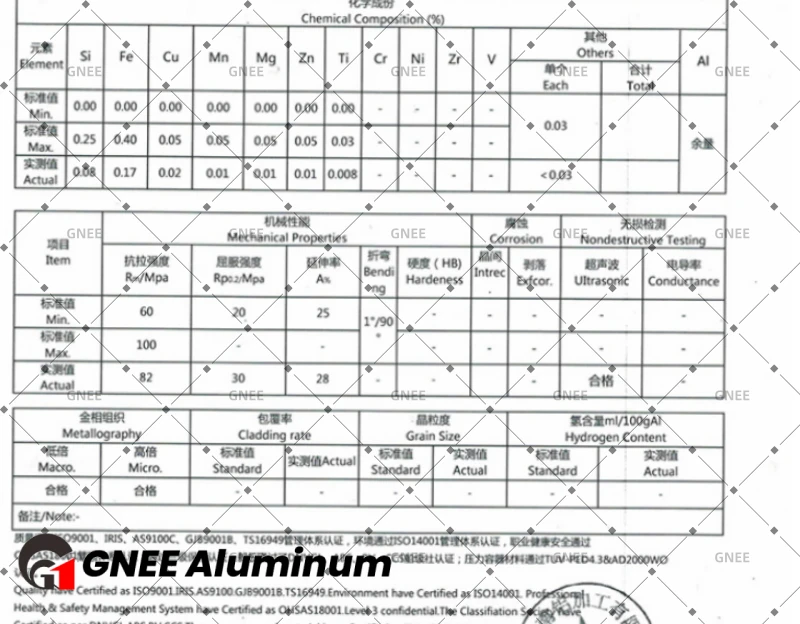
As a procurement manager, how do you verify that your aluminum complies with EN 485-2 and EN 485-4? The answer lies in the inspection documentation.
Reputable manufacturers will issue an EN 10204 3.1 Mill Test Certificate (MTC) with every shipment.
To verify EN 485-2, check the MTC for the actual tensile test results (usually performed on a universal testing machine). The numbers must fall within the range specified by the standard for that specific alloy and temper.
To verify EN 485-4, QC inspectors use calibrated micrometers, laser flatness gauges, and ultrasonic thickness measurement tools before packing to ensure the physical dimensions match the standard's strict tolerance tables.
Need Guaranteed Material Quality for Your Supply Chain?
Stop dealing with inconsistent tolerances and rejected parts. We provide custom 5083 aluminum plate price quotes and cut-to-size services, fully backed by EN 485 compliance and third-party inspection options.
Submit Your RFQ Today for Fast Processing
Aluminum Sheets According to EN 485 Standards
GNEE, a Chinese supplier and 6061 aluminum flat sheet manufacturer, provides aluminum sheets compliant with EN 485-2 and EN 485-4, offering precise mechanical performance and dimensional accuracy for global industrial applications. Whether you are sourcing material for marine shipbuilding, aerospace components, or automotive manufacturing, we ensure every plate meets strict international norms.
By combining advanced rolling mill technology with rigorous quality control, we deliver wholesale aluminum materials that streamline your manufacturing process. Contact us today for a mill test certificate for aluminum strip or plate, and secure a reliable supply chain partner.
