

5052-H32 aluminum is a widely used, non-heat-treatable alloy renowned for its excellent corrosion resistance, good formability, and relatively high strength within its class. The designation "5052" refers to its alloy composition, primarily magnesium and chromium, while "H32" indicates the temper, achieved by strain-hardening through cold rolling followed by low-temperature stabilization to reach a "quarter-hard" state. This makes it particularly suitable for sheet metal applications in the aerospace, marine, automotive, and household appliance industries.
Key Characteristics
Strength: Offers moderate to high strength, further enhanced by the H32 temper.
Corrosion Resistance: Exceptional, making it ideal for marine and other corrosive environments.
Formability: Can be easily bent and shaped into complex forms without cracking, even with sharp angles.
Weldability: Excellent weldability, compatible with common joining methods.
Workability: Easy to handle and fabricate, favored for custom sheet metal projects.

Common Applications
Aerospace: Aircraft fuel tanks and other components.
Marine: Marine equipment and water-exposed parts.
Automotive: Vehicle body panels and components.
General Fabrication: Sheet metal products, appliances, signage, and storage tanks.
Comparison with Other Alloys
Versus 6061-T6: While both alloys provide strength, 5052-H32 is easier to form into complex shapes and offers superior corrosion resistance in certain environments. It is also often more cost-effective for applications requiring bending, forming, and resistance to corrosion.
As a trusted Chinese supplier, GNEE provides high-quality 5052-H32 aluminum sheets, ensuring consistent performance, excellent corrosion resistance, and suitability for diverse industrial and fabrication applications.
5052 H32 Aluminum Material Properties
5052 H32 aluminum is a widely used alloy, prized for its combination of strength, lightweight, excellent corrosion resistance, and good formability, making it ideal for a broad range of applications.
Key Material Properties
Strength: The H32 tempering process provides 5052 H32 aluminum with moderate to high strength.
Ductility: This alloy is easily formed into complex shapes without cracking or breaking.
Corrosion Resistance: Offers outstanding resistance to corrosion, making it suitable for marine and other harsh environments.
Chemical Composition: Contains approximately 2.2% magnesium to enhance strength and 0.25% chromium to improve corrosion resistance. Other elements include iron, silicon, copper, manganese, and zinc.
Yield Strength: Around 228 MPa (33,000 psi), indicating the stress at which the material begins to deform plastically.
Tensile Strength: Approximately 276 MPa (40,000 psi), reflecting the maximum stress the material can withstand before breaking.
Bend Radius: Can be bent into tight radii without cracking, allowing for versatile fabrication.
Density and Weight: Approximately 2.68 g/cm³ (0.0975 lb/in³), roughly one-third the density of steel, making it lightweight and easy to handle.
Applications
5052 H32 aluminum is used in many industries where strength, light weight, and corrosion resistance are essential, including:
Marine equipment and vessels
Transportation components
Pressure vessels
Automotive panels and parts
Window frames and roofing
Aircraft fuel tanks
Electronic enclosures and housings
Food processing and storage equipment
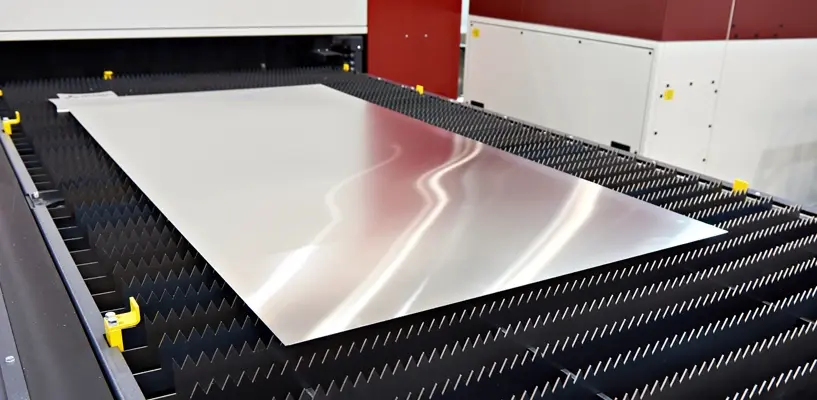
Why 5052 H32 Aluminum is Popular
With its excellent corrosion resistance, balanced strength, and good formability, 5052 H32 aluminum is ideal for demanding environments. Its lightweight nature improves performance and fuel efficiency in vehicles while making fabrication and transport easier. These qualities make it a preferred choice for a wide variety of applications across multiple industries.
As a trusted Chinese supplier, GNEE provides high-quality 5052 H32 aluminum sheets and plates, ensuring reliable performance, consistent material properties, and compliance with international standards for diverse industrial uses.