


Yes, 5083 aluminum can be anodized, but it is not a simple "yes." If you are looking for a bright, colorful, or decorative finish, 5083 is the wrong alloy.
At GNEE, we have supplied marine-grade aluminum for over 18 years, and we always tell our clients the same thing: Anodize 5083 for protection, not for looks.
Because 5083 contains high magnesium (4.0% to 4.9%), the anodizing process creates a dull, dark gray, and sometimes streaky surface.
However, for harsh saltwater environments, this protective oxide layer is exactly what you need.
Let's break down the technical reality of anodizing this alloy so you can make the right sourcing decision.
1. Why Anodizing 5083 Aluminum Plate Behaves Differently
When you decide to buy 5083 aluminum plate for CNC machining or shipbuilding, you need to understand its metallurgy.
The high magnesium content gives 5083 its massive strength and excellent raw corrosion resistance. But during the sulfuric acid anodizing process, this magnesium reacts aggressively. Specifically, a compound called Mg2Al3(the beta phase) tends to precipitate at the grain boundaries.
What does this mean for your project?
- Uneven Coating: The oxide layer grows faster but is less uniform than on 6061 alloys.
- Color Absorption Issues: If you try to dye the plate black or blue, the dye often washes off or looks blotchy because the pore structure of the anodic film is irregular.
- Film Thickness: It is harder to achieve a thick, hard-anodized layer (Type III) on 5083 without burning the material. We usually recommend keeping the coating thickness between 10 to 25 microns for optimal balance.
2. Surface Finish Results of Anodized 5083 Aluminum Sheet
If your engineer is asking for a cosmetic, mirror-like finish on a 5083 aluminum sheet, you should steer them toward 6061 or 5005 alloys.
Here is what actually happens to the surface of 5083 after anodizing:
- Matte Gray Appearance: The standard clear anodizing will turn the sheet a matte, darkish gray. It will not look like raw aluminum anymore.
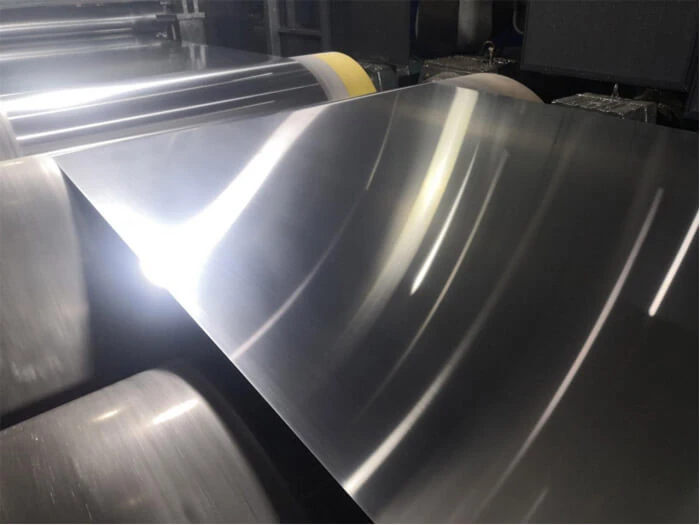
- Visual Streaks: Structural rolls leave lines on the metal. Anodizing magnifies these rolling directions. You will see structural "grain" streaks on the sheet.
- No Bright Dipping: Bright dip anodizing requires high-purity aluminum or specific alloys like 6063. Attempting this on 5083 will result in a muddy, dull surface.
If your part is visible to the end consumer and requires a high-end aesthetic, use 6061-T6 and accept slightly lower corrosion resistance, or paint/powder coat the 5083 instead.
Get a Quick Quote on Marine Grade 5083
Need reliable 5083 plates for your next marine or industrial project? GNEE supplies premium 5083 in H116, H321, and O tempers with full mill certification.
Send us your dimensions and required temper, and our team will provide a competitive quote within 24 hours. Let's make your project durable.
3. Choosing 5083 H116 Aluminum for Harsh Marine Environments
For shipbuilding and offshore equipment, visual looks don't matter-longevity does. This is where you should look to wholesale 5083-H116 aluminum or H321 tempers.
In marine applications, raw 5083 is already great. But adding a Type II (protective) anodized coating creates an impenetrable barrier against chloride ions.
To avoid exfoliation corrosion (a common failure where the aluminum peels in layers), you must use the correct temper. Let's look at the data comparing the two most common marine tempers we supply at GNEE:
5083 Anodizing & Property Comparison
| Property / Feature | 5083-H116 | 5083-H321 | 6061-T6 (For Comparison) |
| Magnesium Content | 4.3 - 4.9% | 4.3 - 4.9% | 0.8 - 1.2% |
| Anodizing Objective | Purely Protective | Purely Protective | Decorative & Protective |
| Visual Result | Matte Dark Gray | Matte Dark Gray | Clear, Bright, or Colorful |
| Corrosion Resistance | Excellent (Saltwater) | Excellent (Saltwater) | Moderate |
| Exfoliation Resistance | Certified Resistant | Certified Resistant | Not Optimized |
| Best Used For | Boat hulls, decks | Marine structures | Yacht trim, internal fixtures |
Note: Both H116 and H321 tempers are specially processed to prevent the continuous network of beta-phase magnesium at grain boundaries, making them much safer for anodizing and marine use than O (annealed) or H32 tempers.

4. How to Source from a Verified 5083 Aluminum sheet Manufacturer
When looking for a heavy-gauge 5083 aluminum sheet, sourcing becomes critical. Thick blocks have different cooling rates during manufacturing, which can lead to inconsistent magnesium distribution. If the distribution is off, your anodizing will look patchy.
Here is GNEE's advice for procurement managers looking to get a stable 5083 aluminum sheet price and quality:
- Demand Mill Test Certificates (MTC): Ensure the magnesium content is within the 4.0-4.9% range and that it passes the ASTM G67 test for exfoliation corrosion if you are buying H116 or H321.
- Specify End Use: Tell your supplier you plan to anodize. We can select slabs with better surface grain structures to minimize streaking.
- Do a Sample Run: Never send a batch of 1,000 machined 5083 parts to the anodizer at once. Run 5 pieces first to check if the gray tone meets your functional acceptance criteria.
At GNEE, we provide cut-to-size 5083 plates and blocks with full traceability. We don't just sell metal; we make sure the metal fits your post-processing needs.


