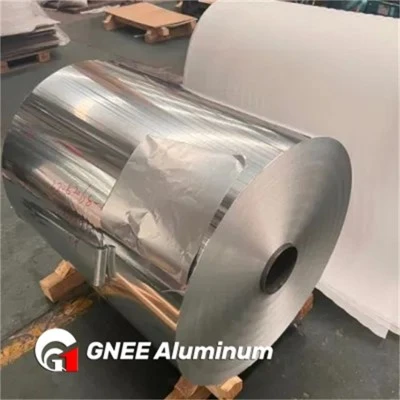
Why is aluminum foil used for lithium battery cathodes instead of copper?
Aluminum foil is preferred for cathodes because it forms a stable passivation layer that prevents oxidation at high voltages (up to 4.5V vs. Li/Li+), whereas copper would oxidize and degrade. Its natural oxide layer (2-5nm thick) provides corrosion resistance while maintaining good conductivity. Aluminum's lighter weight (2.7 g/cm³ density vs. copper's 8.96 g/cm³) improves energy density. Additionally, aluminum is more cost-effective for large-scale production. The alloy's ductility allows rolling into ultra-thin foils (8-20μm) without cracking.
What are the key differences between 1xxx, 3xxx and 8xxx series aluminum alloys for cathode foils?
1xxx series (e.g., 1070, 1235) offer highest purity (99.3-99.7% Al) for optimal conductivity but lower strength. 3xxx series (e.g., 3003) contain manganese for improved mechanical properties but reduced electrochemical stability. 8xxx series (e.g., 8079) balance purity (99.8% Al) with iron/silicon additives for enhanced formability and puncture resistance. Surface treatments vary - 1xxx foils often receive hydrophilic coatings, while 8xxx alloys may need deeper etching due to intermetallic particles. Battery manufacturers select alloys based on voltage requirements and production processes.
How does foil surface roughness impact battery performance?
Controlled roughness (Ra 0.1-0.4μm) increases active material adhesion by 30-50% through mechanical interlocking. Excessive roughness (>0.5μm) can cause localized current hotspots and accelerate degradation. Laser-textured surfaces with 10-50μm patterns are being tested to improve slurry anchoring without compromising conductivity. The oxide layer's porosity also affects interfacial resistance - dense anodic films (20-100nm) sometimes replace natural oxides for high-voltage applications. Optimal topography depends on the cathode chemistry (NMC, LFP, etc.).
What quality control tests are critical for cathode aluminum foil production?
Four-point probe measurements ensure sheet resistance <0.1 Ω/sq for 15μm foil. Thickness uniformity must be within ±0.5μm across rolls to prevent current distribution issues. Pinhole detectors scan for defects exceeding 20μm diameter at ≥500m/min speeds. Peel strength tests verify electrode adhesion meets ≥1.2N/cm standards. Electrochemical impedance spectroscopy (EIS) evaluates interface stability after 500 cycles at 4.3V. Statistical process control maintains CpK>1.33 for all critical parameters.
What innovations are emerging in cathode foil technology?
Ultrathin 6-8μm foils with polymer reinforcement layers are enabling 5% higher energy density. Self-healing coatings containing conductive polymers automatically repair micro-cracks during cycling. Recycled-content foils now achieve 99.6% purity through advanced smelting filters, reducing carbon footprint by 40%. Some manufacturers are developing bimetallic foils with aluminum-core/copper-clad structures for high-power applications. AI-driven defect detection systems now achieve 99.98% yield rates in mass production. These advances collectively target <$0.5/m² cost at >500Wh/kg performance.