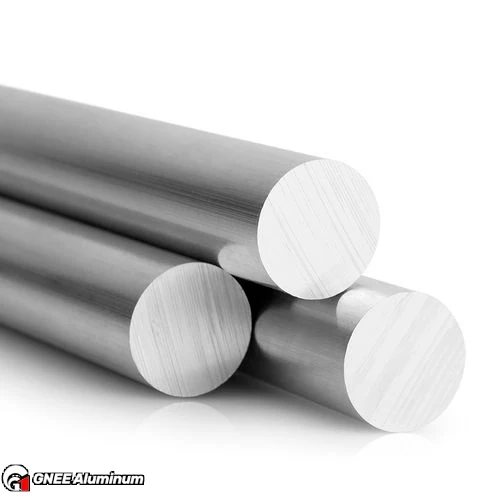
Aluminum bar processing technology
1. Basic forming technology
Extrusion forming
Cold extruded aluminum bar: Applicable to 1XXX series pure aluminum (such as 1050 aluminum bar), formed by die pressure, with an accuracy of ±0.1mm, commonly used as electronic heat sink substrate;
Hot extruded aluminum bar: For 6XXX series (6063 aluminum bar) and 7XXX series (7075 aluminum bar), extruded after heating to 450-500℃, complex cross-sections (such as hexagonal bars, I-beam bars) can be achieved, and the tensile strength is increased by 15%-30%13.
Forging process
Free forging: Used for large-size 2XXX series aluminum bars (such as 2014 aviation aluminum bars), improve grain streamlines, and extend fatigue life by 50%;
Die forging forming: Produce high-precision automotive connecting rods (6082-T6 aluminum bars), with a single piece weight error of ≤0.5% and a material utilization rate of 85%25.
2. Modification and strengthening process
Heat treatment process
T6 treatment: Heat the 6061 aluminum bar to 530℃ for quenching, and then age for 16 hours, the hardness is increased from HB 60 to 95; T5 treatment: For the extruded 6063 aluminum bar, artificial aging at 170℃×8 hours, the yield strength is increased to 215MPa47.
Alloying modification
Microalloyed aluminum bar: 5083 aluminum bar with 0.2%Sc added, the corrosion resistance is increased by 3 times; High silicon aluminum bar (such as AlSi12), with a silicon content of 12%, the casting fluidity is increased by 40%, suitable for engine cylinder 6.
3. Surface treatment technology
Anodizing
Hard oxidation: 50μm oxide film is generated on the surface of 7075 aluminum rod, microhardness HV 400-500, and friction coefficient is reduced to 0.15; Color oxidation: 6063 aluminum rod is electrolytically colored to achieve bronze/champagne gold, and color fastness reaches level 8 (ISO 105-B02 standard)35. Spraying process
Electrostatic powder spraying: 5052 aluminum rod surface spraying thickness 60-120μm, salt spray resistance >1000 hours; Fluorocarbon spraying: PVDF coating on the surface of 6061-T6 aluminum rod, weather resistance 30 years (ASTM D2244 test)17. Special coating
Micro-arc oxidation: Generate a ceramic layer on the surface of 2A12 aluminum rod, breakdown voltage>3000V, insulation resistance>10^12Ω·cm; Chemical nickel plating: 2024 aluminum rod coating thickness 15μm, hardness HV 550, suitable for hydraulic valve body 26.
4. Precision machining technology
CNC cutting
Free-cutting aluminum rod: 2011 aluminum rod contains 0.4% lead, cutting speed can reach 500m/min (60% faster than 6061), surface roughness Ra≤0.4μm; Thin-wall machining: 7075-T7351 aluminum rod milling wall thickness 0.5mm, deformation <0.02mm45.
Spinning Forming
Lighting Aluminum Rod: 1050-O aluminum rod is spun into a spherical lampshade, with an elongation of ≥35% and a thickness reduction rate of ≤20%; Military Parts: 5083 aluminum rod is spun into a missile shell, with a tensile strength retention rate of >95%37.
5. Special Function Process
Welding Technology
Friction Stir Welding: Connecting 6061-T6 aluminum rods, the weld strength reaches 90% of the parent material; Laser Welding: Welding 0.5mm thick 5052 aluminum rods, with a penetration control accuracy of ±0.05mm26.
Composite Materials Process
Carbon Fiber Coating: Wrapping CFRP on the surface of 7075 aluminum rods, the bending stiffness is increased by 200%; Aluminum-based SiC Reinforcement: 6092 aluminum rods add 20% silicon carbide, and the thermal expansion coefficient is reduced to 15×10^-6/℃14.
6. Process Selection Comparison Table
Process Type Applicable Brand Core Advantages Typical Application Scenarios
Hot Extrusion 6063, 7075 Complex cross-section one-time molding Building curtain wall keel
T6 heat treatment 6061, 6082 Strength increased to 310MPa Robot joint arm
Hard Anodizing 2A12, 7075 Surface hardness HV>400 Aerospace fasteners
Powder Coating 5052, 6061 Weather resistance>20 years Outdoor engineering machinery housing
Friction Stir Welding 5083, 6061-T6 Weld without pores/cracks High-speed rail carriage structural parts