

6061 Aluminum Alloy Overview: Properties, Composition, and Comparisons
General Characteristics of 6061 Aluminum Alloy
6061 aluminum alloy is a widely used heat-treatable material known for its medium to high strength and excellent overall performance. It offers a balanced combination of corrosion resistance, weldability, workability, and machinability, making it suitable for a broad range of industrial and structural applications.
Key characteristics of 6061 aluminum alloy:
Strength: Medium to High
Corrosion Resistance: Good
Weldability & Brazability: Good
Workability: Good
Machinability: Good
Through proper tempering, the mechanical strength and corrosion resistance of 6061 aluminum can be further enhanced. As a professional aluminum supplier, GNEE provides 6061 aluminum products in multiple tempers to meet different engineering requirements.
6061-T4 vs. 6061-T6 Aluminum: Material Property Differences
6061 aluminum is typically solution heat treated and then aged. The aging process determines the final temper and performance characteristics.
6061-T4 aluminum is naturally aged after solution heat treatment.
6061-T6 aluminum is artificially aged to achieve maximum strength.
These two tempers are commonly used in applications that require different balances of strength and formability.
Physical Properties of 6061 Aluminum Alloy
The density of 6061 aluminum remains consistent regardless of temper condition. There is no density difference between 6061-T4 and 6061-T6.
Density:
2.70 g/cc | 0.0975 lb/in³ (T4 and T6)
This low density contributes to the alloy's excellent strength-to-weight ratio.
Mechanical Properties of 6061-T4 and 6061-T6 Aluminum
The mechanical performance of 6061 aluminum varies significantly between tempers, especially in tensile and yield strength.
6061-T4 Aluminum:
Tensile Strength: 241 MPa | 35,000 psi
Yield Strength: 145 MPa | 21,000 psi
Modulus of Elasticity: 68.9 GPa | 10,000 ksi
6061-T6 Aluminum:
Tensile Strength: 310 MPa | 45,000 psi
Yield Strength: 276 MPa | 40,000 psi
Modulus of Elasticity: 68.9 GPa | 10,000 ksi
The T6 temper provides a substantial strength increase while maintaining good machinability and structural reliability.
Thermal Properties of 6061 Aluminum Alloy
6061 aluminum demonstrates stable thermal behavior across different tempers, making it suitable for applications involving temperature changes.
Coefficient of Thermal Expansion (20–100°C):
23.6 µm/m-°C | 13.1 µin/in-°F (T4 and T6)
Thermal Conductivity:
6061-T4: 154 W/m-K | 1070 BTU-in/hr-ft²-°F
6061-T6: 167 W/m-K | 1160 BTU-in/hr-ft²-°F
These properties support the alloy's use in heat dissipation and structural thermal applications.
Chemical Composition of 6061 Aluminum Alloy
6061 aluminum belongs to the 6000 series, with magnesium and silicon as its primary alloying elements. Magnesium improves strength, while silicon lowers the melting temperature and enhances castability.
Typical Chemical Composition Limits:
Magnesium (Mg): 0.8 – 1.2
Silicon (Si): 0.4 – 0.8
Iron (Fe): ≤ 0.7
Copper (Cu): 0.15 – 0.4
Manganese (Mn): ≤ 0.15
Chromium (Cr): 0.04 – 0.35
Zinc (Zn): ≤ 0.25
Titanium (Ti): ≤ 0.15
Other elements: ≤ 0.05 each, 0.15 total
This balanced composition explains the alloy's versatility and widespread industrial adoption.
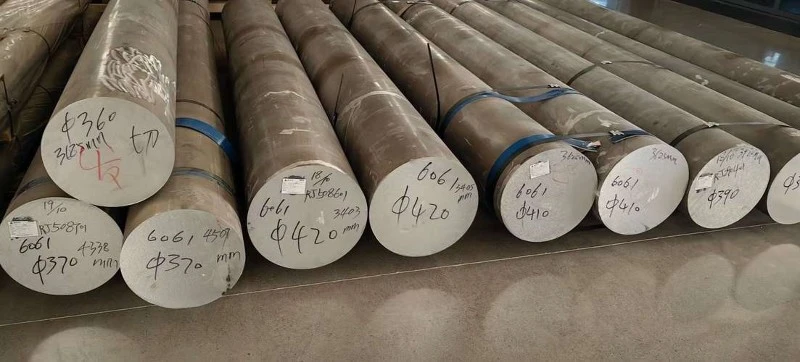
6061 Aluminum vs. Other Common Aluminum Alloys
6061 Aluminum vs. 7075 Aluminum
7075 aluminum is alloyed primarily with zinc and is one of the highest-strength aluminum alloys available. It offers significantly higher strength than 6061 but has lower corrosion resistance and is more difficult to weld.
6061: Better corrosion resistance, weldability, and versatility
7075: Extremely high strength for aerospace, automotive, and defense applications
7075 is often used where strength is the top priority, such as in aircraft structures, firearm components, and high-performance frames.
6061 Aluminum vs. 6063 Aluminum
6061 and 6063 are the two most commonly used extrusion alloys in the 6000 series.
6061 aluminum: Higher strength, suitable for structural and load-bearing applications
6063 aluminum: Better surface finish and corrosion resistance, preferred for architectural uses such as railings, windows, doors, and trim
Both alloys share similar chemical foundations, but their performance targets differ.
6061 Aluminum vs. 5052 Aluminum
5052 aluminum uses magnesium as its primary alloying element and is known for excellent weldability and corrosion resistance, especially in marine environments.
6061: Heat treatable, higher strength, broader structural applications
5052: Not heat treatable, superior weldability, commonly used for marine and welded components
When welding performance is critical, 5052 may be preferred.
6061 Aluminum vs. 2024 Aluminum
2024 aluminum is mainly alloyed with copper and is widely used in aerospace applications requiring high strength and fatigue resistance.
6061: Better corrosion resistance, weldability, and machinability
2024: Higher strength but poorer corrosion resistance and weldability
2024 is often applied in aircraft wing and fuselage structures under high stress.
Summary: Why Choose 6061 Aluminum Alloy
6061 aluminum alloy is one of the most versatile and widely used structural aluminum materials. Its excellent balance of strength, corrosion resistance, machinability, and weldability makes it suitable for a wide range of applications, from structural frameworks to precision components.
As a trusted aluminum supplier, GNEE offers 6061 aluminum plates, bars, tubes, and extrusions in multiple tempers to support industrial, transportation, construction, and engineering projects worldwide.
