

3003-vs.-5052-Aluminum-Alloy-sheet-What's-the-Difference.pdf
3003 aluminum alloy (Al-Mn-Cu alloy, UNS A93003, China GB grade 3003) and 5052 aluminum alloy (Al-Mg-Cr alloy, UNS A95052, China GB grade 5052) are both non-heat-treatable alloys, meaning their strength is achieved exclusively through cold work hardening rather than quenching or aging. The primary differences between the two stem from their alloy systems: 3003 is an Al-Mn series alloy with manganese as the main alloying element, while 5052 is an Al-Mg series alloy with magnesium as the primary element. These differences are further influenced by processing tempers (annealed, cold-worked, or partially annealed) and are reflected in properties such as corrosion resistance, weldability, and surface treatment.
Core Properties Comparison (All Tempers)
| Property | 3003 Aluminum Alloy | 5052 Aluminum Alloy |
|---|---|---|
| Alloy System | Al-Mn (1.0–1.5% Mn) + trace Cu (0.05–0.2%) | Al-Mg (2.2–2.8% Mg) + Cr (0.15–0.35%) |
| Standards | China GB 3003; international equivalents | China GB 5052; international equivalents |
| Density | 2.73 g/cm³ | 2.68 g/cm³ (1.8% lower; minor impact on weight) |
| Embodied Carbon | 8.1 kg CO₂/kg | 8.6 kg CO₂/kg (6% higher due to Mg refining) |
| Thermal Conductivity | 180 W/m-K | 140 W/m-K (22% lower) |
| Electrical Conductivity | 44% IACS | 35% IACS (20% lower) |
| Solidus–Liquidus Temp. | 640–650°C | 610–650°C (wider range) |
| Corrosion Resistance | Good; suitable for humid environments, fresh water, food acids | Excellent; withstands outdoor, humid, and complex environments |
| Cost | Lower | Higher (~RMB 2,000–3,000/ton more) |
| Applicable Specifications | Mainly thin plates | Thin & thick plates; broader application |
| Heat Treatment Strengthening | None | None |
Performance by Temper
1. Annealed Temper (O Temper)
Purpose: Maximizes ductility for large deformation applications.
Mechanical Properties:
| Property | 3003-O | 5052-O | Difference |
|---|---|---|---|
| UTS | 110 MPa | 190 MPa | 5052 is 73% stronger |
| Proof Strength | 40 MPa | 79 MPa | 5052 is 98% stronger |
| Hardness | 28 HB | 47 HB | 5052 is 68% harder |
| Elongation | 28% | 22% | 3003 has 27% better ductility |
| Fatigue Strength | 50 MPa | 110 MPa | 5052 is 120% higher |
Applications:
3003-O: Deep-drawn products, beverage cans, liquid containers in humid environments.
5052-O: Formable components under moderate loads, suitable for anodization/polishing.
2. As-Fabricated Temper (H112)
Purpose: For thick-section components without further cold work.
| Property | 3003-H112 | 5052-H112 | Difference |
|---|---|---|---|
| UTS | 110 MPa | 200 MPa | 5052 82% stronger |
| Proof Strength | 45 MPa | 89 MPa | 5052 98% stronger |
| Hardness | 32 HB | 55 HB | 5052 72% harder |
| Elongation | 15% | 9.5% | 3003: 58% better ductility |
Applications:
3003-H112: Low-stress thick components (heat exchanger shells, ventilation ducts).
5052-H112: Thick-walled structural parts (ship plates, heavy machinery frames).
3. Cold-Worked Temper (H1 Series: H12–H19)
Purpose: Strength via cold working; higher numbers = higher strength, lower ductility.
| Temper | 3003 UTS | 5052 UTS | Difference |
|---|---|---|---|
| H12 | 130 MPa | 230 MPa | 5052 77% stronger |
| H14 | 160 MPa | 250 MPa | 5052 56% stronger |
| H16 | 180 MPa | 270 MPa | 5052 50% stronger |
| H18 | 210 MPa | 300 MPa | 5052 43% stronger |
| H19 | 240 MPa | 320 MPa | 5052 33% stronger |
Applications:
3003-H12/H14: Low-load components (electronic housings, brackets, packaging).
5052-H18/H19: High-stress parts (bicycle frames, automotive safety beams, high-strength fasteners).
4. Cold-Worked + Partially Annealed (H2 Series: H22–H28)
Purpose: Balance strength and ductility via partial annealing after cold work.
| Temper | 3003 UTS | 5052 UTS | Difference |
|---|---|---|---|
| H22 | 140 MPa | 230 MPa | 5052 64% stronger |
| H24 | 160 MPa | 250 MPa | 5052 56% stronger |
| H26 | 180 MPa | 270 MPa | 5052 50% stronger |
| H28 | 210 MPa | 310 MPa | 5052 48% stronger |
Applications:
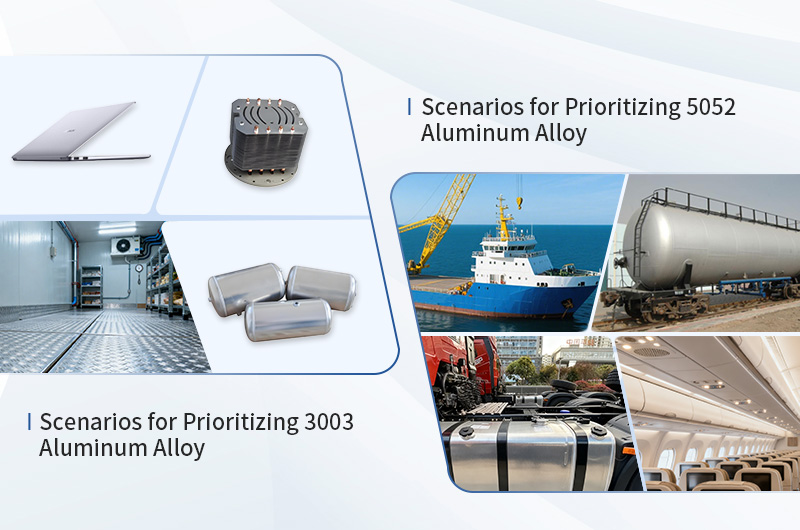
3003-H22/H24: Components requiring good formability and moderate strength (heat sinks, refrigeration parts).
5052-H26/H28: Components needing high strength with moderate ductility (vehicle parts, aircraft fuel tanks, pressure vessels).
Summary of Key Differences
Strength & Fatigue: 5052 is 1.3–2× stronger with higher hardness and fatigue resistance; it is ideal for high-load structural parts.
Ductility & Deep Drawing: 3003 excels in annealed or low-cold-worked tempers; 5052 dominates in partially annealed tempers.
Process Compatibility: 5052 supports anodization/polishing; both alloys weld well, but 5052 has stronger joints. 3003 has poorer machinability.
Corrosion Resistance: 5052 is better for complex/outdoor conditions; 3003 is suitable for humid environments.
Cost & Specifications: 5052 costs RMB 2,000–3,000 more per ton and is available in thin and thick plates. 3003 mainly thin plates.
Thermal & Electrical Conductivity: 3003 is 22–25% higher, better for heat dissipation or electrical applications.
Scenario-Based Selection Guide
| Requirement | Prioritize 3003 | Prioritize 5052 |
|---|---|---|
| Environment | Humid (ventilation ducts, liquid containers) | Outdoor/complex (vehicles, ship components, pressure vessels) |
| Forming Needs | Deep drawing, large deformation | Moderate forming, minor subsequent processing |
| Structural Load | Low load, lightweight | High load, fatigue resistance |
| Process/Appearance | Simple welding, no anodization | Anodization/polishing, high-strength welding |
| Specifications/Cost | Thin plates, low-cost | Thin & thick plates, cost acceptable |

Conclusion
3003 aluminum (Al-Mn series) emphasizes ductility, conductivity, and deep drawing, suitable for low-load or heat dissipation applications.
5052 aluminum (Al-Mg series) focuses on high strength and corrosion resistance, making it ideal for medium-to-high loads and harsh environments. Selection should align with strength requirements, formability, and service conditions.
GNEE supplies both 3003 and 5052 aluminum alloys, available in various tempers and thicknesses, catering to a wide range of industrial and marine applications.