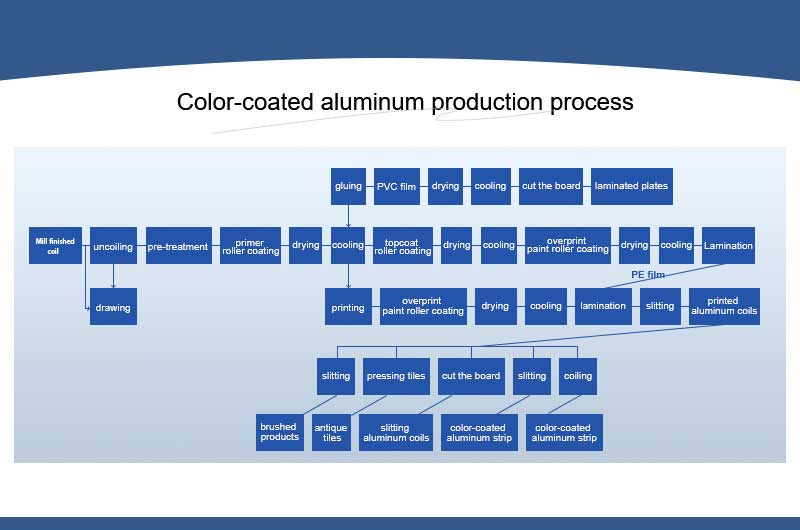
Step 1: Pre-treatment prior to color coating.
Prior to applying any coating, the aluminum surface must be adequately prepared to ensure uniform adherence and surface stability.
Surface processing: Mechanical treatments like brushing, polishing, and embossing are used to improve surface flatness and produce beautiful textures.
The aluminum strip is washed with hot water to remove rolling oil residues, grime, and contaminants.
Hot alkali degreasing: An alkaline solution treatment removes grease and leaves the metal surface cleaner and brighter.
Passivation treatment involves applying a chemical conversion layer to improve corrosion resistance and paint adherence, creating the groundwork for the coating's long-term endurance.
Step 2: Roller coating (single layer)
This stage involves applying the first layer of paint, which is usually primer.
Primer roller coating: A consistent layer of primer is applied to the treated aluminum strip. The primer functions as a bonding layer, ensuring that the paint adheres properly.
Drying: The coated strip is heated in an oven to cure the primer.
Cooling: The strip is cooled to help stabilize the primer film before proceeding to the next coating stage.
Step 3: Apply topcoat roller coating (double coating).
The second layer of paint, which is typically a decorative and protective topcoat, is applied.
Topcoat roller coating: Adds color, gloss, and corrosion protection. Depending on the end-use requirements, there are several alternatives available, such as polyester (PE), polyvinylidene fluoride (PVDF), or high-durability coatings.
Drying: To achieve maximum hardness and resilience, the coated strip is cured at high temperatures.
Cooling: Controlled cooling keeps the coating stable and prevents surface flaws.
Step 4: Complete the paint roller coating (triple coating).
A third layer of paint can be applied for improved performance and aesthetics.
Finishing paint roller coating: Improves weather resistance, abrasion resistance, and visual appearance; commonly used in high-end architectural or outdoor applications.
Drying: Heat curing ensures that the finish layer adheres thoroughly.
Cooling stabilizes the entire multilayer coating system.
Lamination: Protective films can be used to prevent scratches during transit and processing.
Step 5: Further processing
After coating, the coils are subjected to post-production processes to ensure that they satisfy customer specifications.
Slitting: Cutting the coil into narrower strips for various applications.
Sheets are cut to specific dimensions for use in curtain walls, roofing, ceiling panels, and appliance panels.
Other manufacturing steps include embossing, applying protective coating, and inspecting the surface to assure quality.